How to Get DPIIT Certification for Startups in India
Starting a business in India has become significantly easier in recent years. However, despite growing opportunities, many startups still struggle with funding, taxation, and regulatory hurdles. This is exactly where DPIIT Certification for Startups plays a transformational role.
In fact, DPIIT recognition is not just a certificate — it is a gateway to government-backed financial support, tax exemptions, compliance relaxations, and credibility in the market.
Therefore, if you are building a startup or planning to launch one, understanding DPIIT certification is absolutely essential.
What is DPIIT Certification?
DPIIT (Department for Promotion of Industry and Internal Trade) operates under the Ministry of Commerce and Industry, Government of India.
DPIIT certification is an official recognition granted to eligible startups under the Startup India Initiative, launched in 2016.
👉 Official Startup India Portal:
https://www.startupindia.gov.in
In simple terms, DPIIT certification formally recognizes your business as a startup under Government of India guidelines.
Why DPIIT Certification is Important for Startups
Many founders assume DPIIT is optional. While technically it is, strategically it is extremely powerful.
Here’s why:
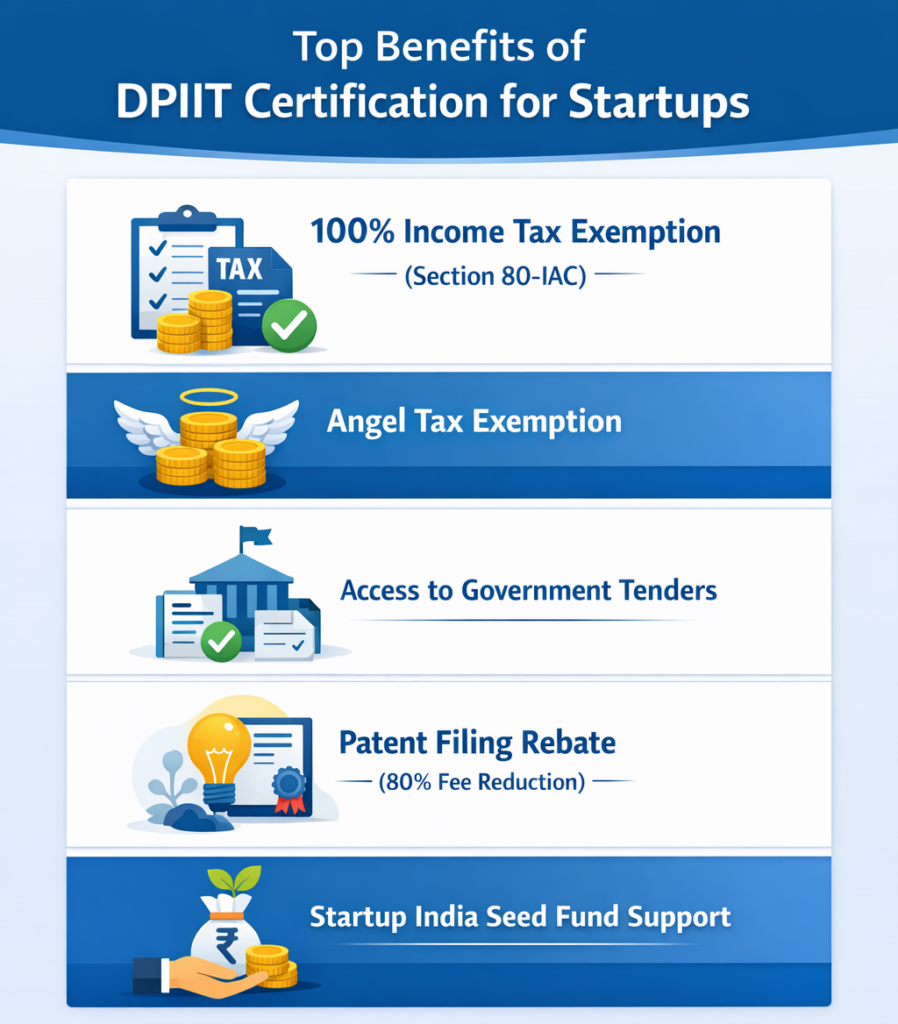
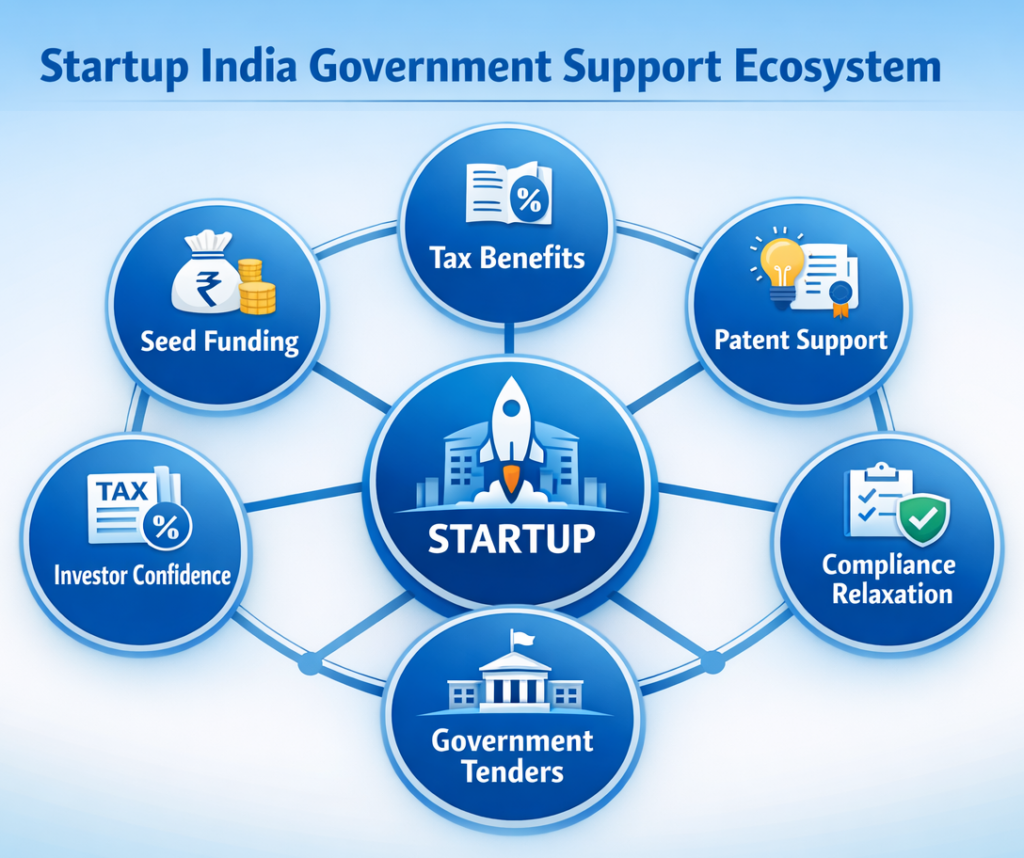
1. Income Tax Exemption (Section 80-IAC)
Eligible startups can claim 100% income tax exemption for 3 consecutive financial years within the first 10 years of incorporation.
Reference:
Income Tax Act Section 80-IAC
https://www.incometaxindia.gov.in
2. Angel Tax Exemption
DPIIT-recognized startups can get exemption under Section 56(2)(viib) (Angel Tax), which protects them from excessive taxation on funding.
3. Easier Access to Government Tenders
Unlike normal companies, DPIIT startups are exempted from:
- Prior experience requirements
- Minimum turnover criteria
This significantly improves chances in public procurement.
4. Self-Certification Under Labour & Environmental Laws
Startups can self-certify compliance under 6 labour laws and 3 environmental laws — reducing regulatory burden.
5. Fund of Funds for Startups (FFS)
The Government has established a ₹10,000 crore Fund of Funds to boost startup investments.
Who is Eligible for DPIIT Certification?
Before applying, you must understand eligibility criteria.
📌 Basic Eligibility Criteria
Your business must:
- Be incorporated as:
- Private Limited Company
- Limited Liability Partnership (LLP)
- Registered Partnership Firm
- Be less than 10 years old
- Have annual turnover below ₹100 crore
- Be working towards innovation, development, or improvement of products/services
- Not be formed by splitting up an existing business
If your company meets these criteria, you can apply online through the Startup India portal.
Step-by-Step Process to Apply for DPIIT Certification
The process is entirely online and relatively simple.
Step 1: Incorporate Your Business
Register under MCA (Ministry of Corporate Affairs).
https://www.mca.gov.in
Step 2: Register on Startup India Portal
Create an account and fill startup recognition form.
Step 3: Submit Required Documents
You will need:
- Certificate of Incorporation
- PAN details
- Brief write-up about innovation
- Pitch deck (optional but recommended)
Step 4: Get Recognition Certificate
If approved, you receive a DPIIT Recognition Number.
Processing usually takes 2–7 working days if documentation is correct.
DPIIT Certification vs MSME Registration
Many founders confuse these two registrations. However, they serve different purposes.
| Feature | DPIIT | MSME |
|---|---|---|
| Focus | Innovation-based startups | Small & medium enterprises |
| Tax Benefits | Yes (80-IAC) | No direct income tax exemption |
| Angel Tax Exemption | Yes | No |
| Government Tenders Relaxation | Yes | Limited |
Therefore, innovative startups should ideally register under both if eligible.
Key Government Benefits Under Startup India Scheme
1️⃣ Fast-Track Patent Filing
Startups get:
- 80% rebate on patent filing fees
- Fast examination process
Reference:
IP India Official Portal
https://ipindia.gov.in
2️⃣ Startup India Seed Fund Scheme (SISFS)
The scheme provides financial assistance up to ₹50 lakh for product development and commercialization.
Official Link:
https://seedfund.startupindia.gov.in
3️⃣ Credit Guarantee Scheme
Collateral-free loans are supported under government guarantee frameworks.
Common Mistakes Startups Make During DPIIT Application
Despite the simple process, many startups face rejection due to:
- Vague innovation description
- Copy-paste business model explanation
- Lack of scalability explanation
- Not demonstrating uniqueness
Therefore, always clearly explain:
- What problem are you solving?
- How is it innovative?
- What is your market impact?
How DPIIT Certification Improves Funding Opportunities
Investors often prefer DPIIT-recognized startups because:
- Government validation increases credibility
- Angel tax exemption reduces investor risk
- Eligibility for government schemes improves survival rate
Consequently, DPIIT certification indirectly boosts valuation confidence.
Real Impact of DPIIT on Indian Startup Ecosystem
Since the launch of Startup India:
- 100,000+ startups recognized
- Thousands benefited from tax exemptions
- Billions raised in funding
India is now one of the top startup ecosystems globally.
This clearly shows that DPIIT recognition is not symbolic — it is structural support.
Is DPIIT Certification Mandatory?
No, it is not mandatory.
However, if your goal is:
- Raising funding
- Applying for tax exemptions
- Participating in government tenders
- Building long-term scalability
Then DPIIT certification becomes strategically essential.
When Should You Apply?
Ideally:
- Immediately after incorporation
- Before raising angel funding
- Before claiming tax benefits
The earlier you apply, the better your compliance positioning.
Future of DPIIT & Startup India
The Government continues to expand:
- Seed funding programs
- Digital compliance
- State-level startup policies
- AI & deep-tech incentives
Therefore, DPIIT recognition is becoming even more valuable in emerging sectors.
Final Thoughts: Should You Get DPIIT Certification?
If your startup is innovation-driven, scalable, and growth-focused — the answer is YES.
DPIIT certification provides:
- Tax relief
- Funding advantages
- Legal protection
- Market credibility
- Government ecosystem access
In today’s competitive environment, ignoring such benefits would mean missing structured growth support.