
Find Clues from Social Media Profiles: The Ultimate Guide to Understanding Digital Behavior in 2026
In today’s hyper-connected world, every social media profile tells a story. From profile pictures to captions, from emojis to engagement patterns, users unknowingly leave behind digital clues that reveal personality traits, intentions, interests, authenticity, and sometimes even risks. Therefore, learning how to find clues from social media profiles has become an essential skill for businesses, marketers, recruiters, cybersecurity teams, and digital investigators alike.
Moreover, with the rapid rise of fake profiles, bots, impersonators, and misleading online behavior, it is more important than ever to understand what lies beneath the surface. This is exactly where platforms like BotDef help identify suspicious or automated behavior, and tools like ViaDM support real, personalized human conversations instead of automation.
In this detailed guide, we will walk you through how to ethically and effectively find clues from social media profiles, step-by-step, using real-world analysis methods, psychology, OSINT techniques, and pattern recognition—while always respecting privacy and platform guidelines.
Why Finding Clues from Social Media Profiles Matters in 2026
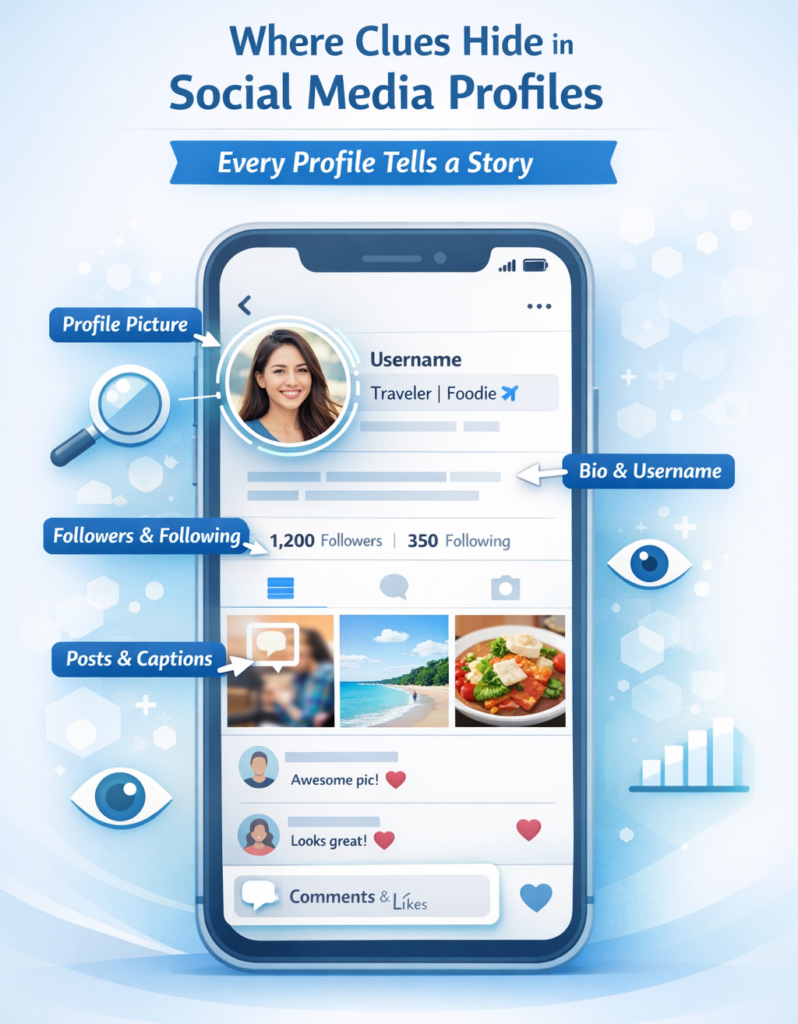
First and foremost, social media is no longer just a place to share photos—it is a digital identity layer. Every user leaves behavioral signals that can help you understand:
- Whether a profile is real or fake
- The intent behind interactions
- The trustworthiness of a user
- The psychology and interests of a person
- Potential risks, scams, or automation
As a result, businesses, influencers, HR professionals, cybersecurity teams, and marketers increasingly rely on profile analysis before engaging.
What Does “Finding Clues” Actually Mean?
When we talk about finding clues from social media profiles, we are not talking about spying. Instead, we are referring to:
Ethical digital observation of publicly available information to understand authenticity, intent, and behavior.
This includes:
- Profile structure analysis
- Content pattern recognition
- Engagement behavior study
- Bio wording interpretation
- Visual consistency checks
- Social graph observation
In other words, it is the art of reading between the lines of digital behavior.
Key Areas Where Clues Exist on Social Media Profiles
Let’s break this down step-by-step.
1. Profile Picture Analysis – The First Visual Clue
The profile photo is often the biggest signal of authenticity.
What to Observe:
- Is it a real human face or stock image?
- Is the image high quality, blurred, cropped, or mismatched?
- Is the face consistent across platforms?
Clue Patterns:
- Stock photos often indicate fake or bot accounts
- Overly perfect images may signal AI-generated profiles
- No face at all may indicate low trust or anonymity intent
2. Bio Section – The Psychology Clue Zone
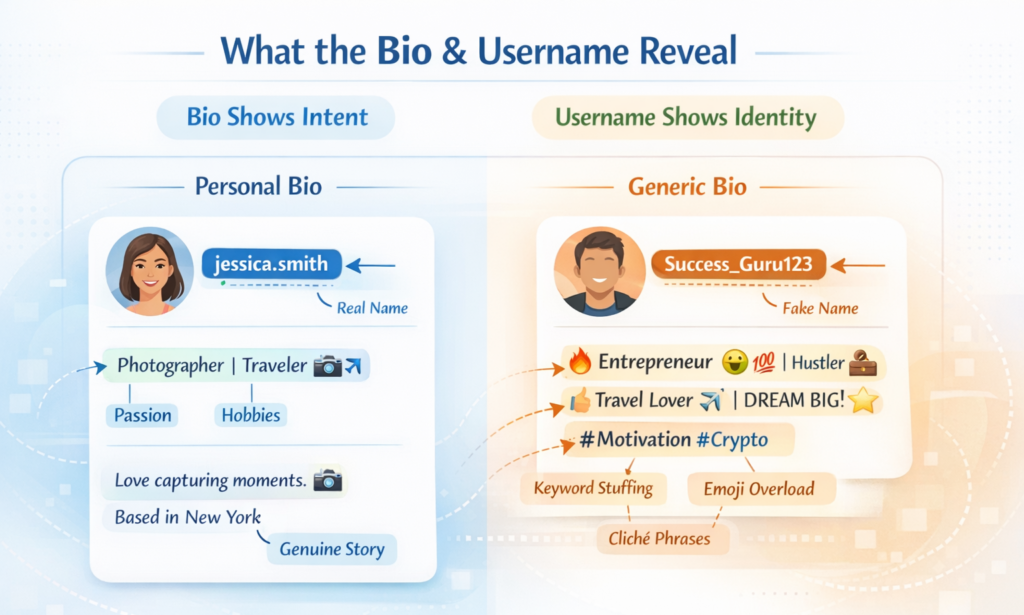
The bio tells you who they want you to believe they are.
What to Look For:
- Overuse of emojis 🚀🔥💰 may signal promotion-focused accounts
- Generic phrases like “Entrepreneur | Hustler | Dreamer” often indicate mass-created profiles
- Poor grammar + copied bios = automation or fake identity
Psychological Clues:
- Personal storytelling = higher authenticity
- Hard selling tone = transactional intent
- Empty bio = low effort or burner account
3. Account Age & History – The Timeline Clue
Older accounts with consistent history are generally more trustworthy.
Observe:
- First post date
- Gaps in posting
- Sudden activity spikes
Clue Interpretation:
- Brand-new accounts + aggressive messaging = 🚩 risk
- Years-old accounts with natural progression = ✅ authentic
4. Content Patterns – The Behavior Clue
Every user has a content fingerprint.
Analyze:
- Type of posts (selfies, quotes, promotions, memes)
- Caption style (personal vs copied)
- Hashtag behavior
What It Reveals:
- Repeated promotional captions = sales intent
- Recycled quotes = low originality
- Personal photos + stories = human behavior
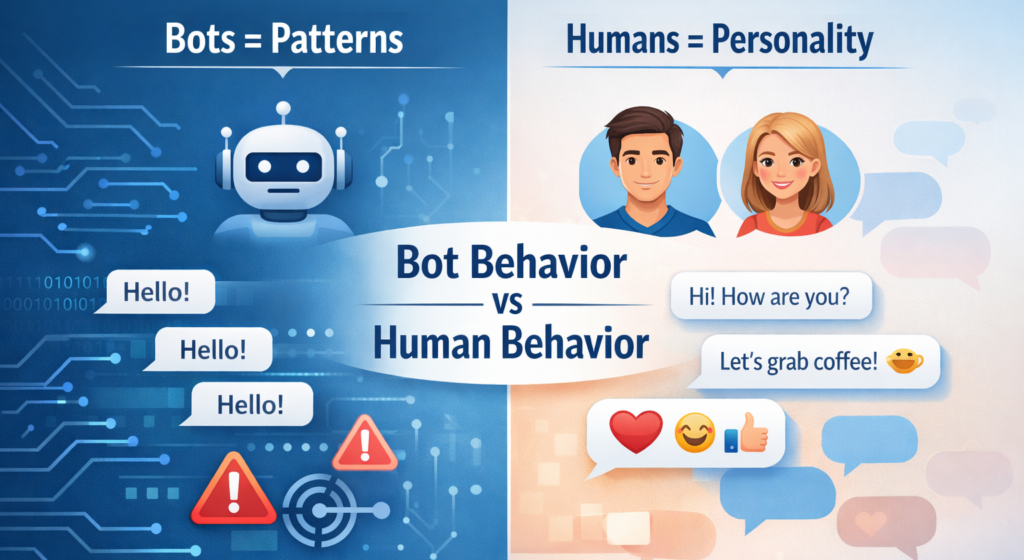
➡️ Pro Tip: Bots often post at perfect intervals. Humans post irregularly.
5. Engagement Style – The Interaction Clue
Engagement tells you more than follower count.
Check:
- Are comments generic? (“Nice”, “Great pic”)
- Are replies contextual?
- Are emojis repeated across posts?
Clue:
- Generic comments = bot network
- Real replies = human community
This is where BotDef becomes powerful, as it identifies bot-like engagement patterns that humans usually miss.
6. Follower–Following Ratio – The Network Clue
A profile following 5,000 people with 100 followers is often growth-hungry or spammy.
However, a balanced ratio usually indicates organic growth.
7. Cross-Platform Consistency – The Identity Clue
Search the same username on:
- Twitter/X
Clue:
- Same profile photo + name = real identity
- Different personalities = suspicious
- No digital footprint = newly created or burner profile
Ethical & Legal Considerations (Very Important)
Before we go deeper, it is critical to understand:
Finding clues ≠ invading privacy.
You must only analyze publicly available information and never:
- Hack accounts
- Access private data
- Use information maliciously
This guide is intended for cyber awareness, digital safety, brand protection, recruitment, and ethical investigation.
Advanced Clue Detection Techniques (Rare Points Most Blogs Miss)
Now let’s go deeper into areas most blogs never explain.
Linguistic Fingerprinting
Every person has a unique writing style.
Repeated phrases across multiple profiles often indicate:
- Content farms
- Automation
- Copy-paste behavior
Time-Zone Activity Patterns
If a profile claims to be in India but posts at 3 AM IST consistently, that can indicate:
- Outsourced operation
- Automation
- Different geographic origin
Emotion vs Event Mismatch
When someone posts “So grateful today” on a tragic news day, it may indicate:
- Scheduled automation
- Low contextual awareness
Again, this is where BotDef’s behavior analysis becomes highly relevant.
Role of BotDef in Profile Analysis
BotDef is designed to:
- Detect automated behavior
- Identify fake accounts
- Analyze engagement patterns
- Flag suspicious activity
➡️ You can explore more here: https://botdef.com
Placing BotDef within your digital strategy helps ensure that the profiles you interact with are real humans, not scripts.
Why Personalized Interaction Matters – ViaDM Perspective
Once you identify real profiles, the next step is engaging them correctly.
This is where ViaDM comes in.
ViaDM is NOT an automation tool.
It is a personalized Instagram DM marketing tool designed for real human conversations.
Unlike bots, ViaDM helps you:
- Send contextual messages
- Build trust
- Maintain natural tone
- Avoid spam filters
➡️ Trustpilot Reviews: https://www.trustpilot.com/review/viadm.co
This aligns perfectly with ethical profile analysis—real people deserve real conversations.
How Profile Clues Improve DM Success
When you analyze a profile before messaging:
- You personalize better
- You avoid sounding robotic
- You increase reply rates
- You reduce blocking/reporting risk
This is exactly why ViaDM + profile analysis = powerful combination.
Use Cases: Who Benefits from Finding Social Media Clues?
- Brands: Identify genuine customers
- HR Teams: Verify candidates
- Influencers: Avoid fake collaborations
- Cybersecurity Teams: Detect impersonation
- Marketers: Improve targeting
- Agencies: Protect reputation
Final Thoughts: Why This Skill Is Future-Proof
In 2026 and beyond, the internet will be filled with:
- AI profiles
- Deepfake identities
- Automated conversations
- Synthetic engagement
Therefore, the ability to find clues from social media profiles will become a critical digital literacy skill.
When combined with:
- BotDef for detection
- ViaDM for human conversation
…you create a powerful, ethical, and high-performing digital strategy.