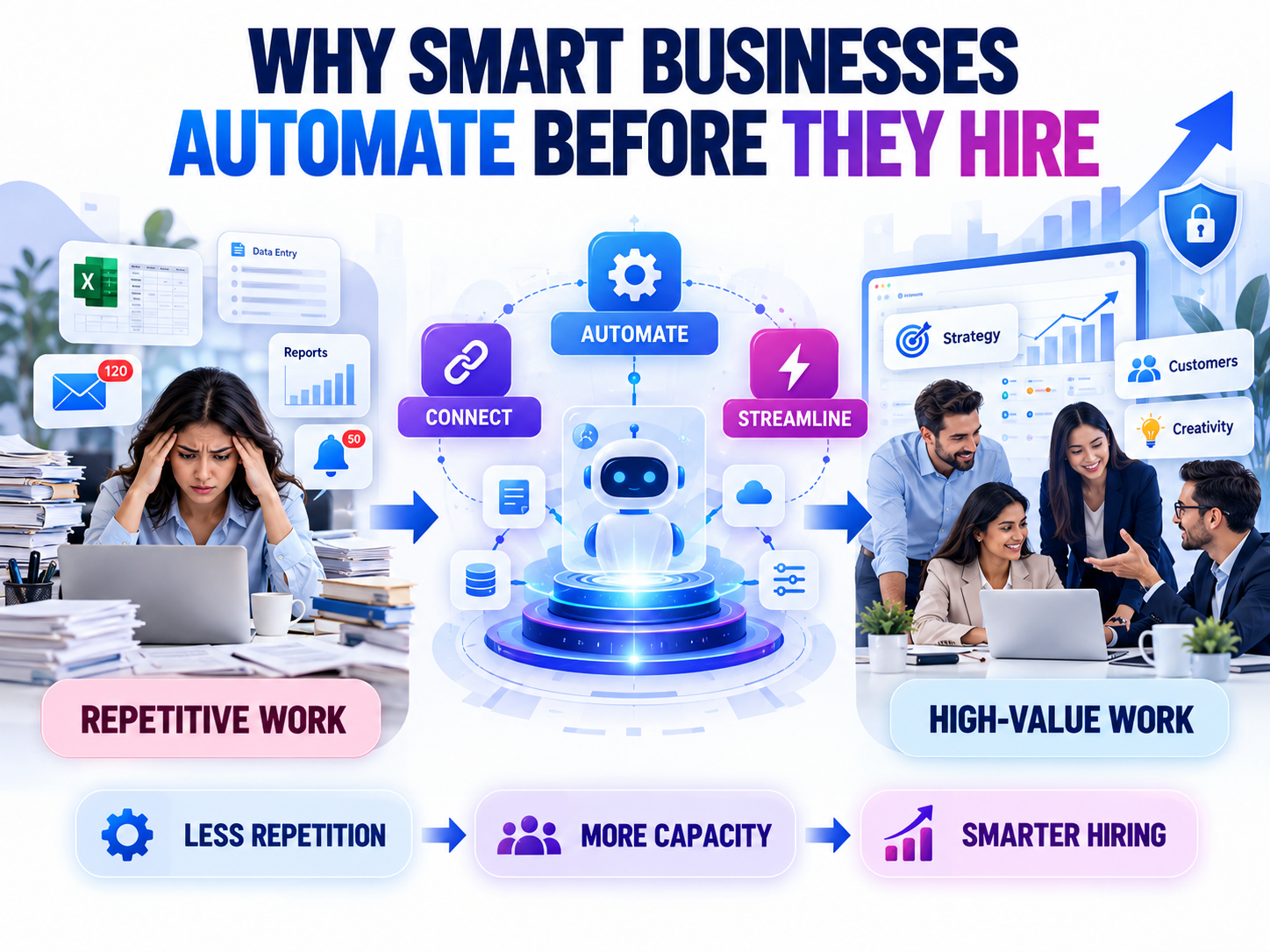
Hiring more people can feel like the obvious answer when a business starts struggling with repetitive work, growing customer demand, or an overloaded team. However, smart businesses increasingly ask a different question first: Can this work be automated before we add another employee?
The idea behind business automation before hiring is not about replacing people. It is about making sure people spend their time on work that genuinely requires judgment, creativity, communication, and expertise. When routine processes are handled efficiently by technology, existing employees can focus on higher-value responsibilities while the business gains capacity without immediately increasing headcount.
Automation can help with tasks such as data entry, reporting, document processing, notifications, customer follow-ups, system monitoring, approvals, and repetitive administrative workflows. When implemented correctly, these improvements can reduce operational friction and make growth more manageable.
For businesses that are also concerned about protecting their systems and information, automation should be designed with security in mind from the beginning. Botdef provides security-focused insights that can help organizations understand why secure technology practices matter as they modernize their operations.
The real question, therefore, is not “Should we automate or hire?” It is:
“What should technology handle, and where do people create the most value?”
That shift in thinking can lead to better hiring decisions, lower operational costs, and more scalable business processes.
What Does “Automate Before You Hire” Actually Mean?
Automate before you hire means evaluating a workload before adding another employee to determine whether part of that workload can be handled through software, integrations, workflows, or other technology.
Imagine a growing company has an employee spending several hours every week:
- Copying information between systems
- Creating routine reports
- Sending standard notifications
- Updating spreadsheets
- Checking whether tasks are completed
- Organizing customer requests
- Moving files between folders
- Performing repetitive system checks
Hiring another person may temporarily reduce the pressure. However, if the underlying process remains inefficient, the company has simply added another person to an inefficient system.
Automation takes a different approach.
Instead of asking someone to repeatedly perform the same predictable task, the business can create a workflow that completes the task automatically or reduces the amount of manual work required.
The employee then supervises the process, handles exceptions, and focuses on more meaningful work.
This is the foundation of business automation before hiring.
Why Smart Businesses Automate Before Hiring
1. Automation Can Increase Capacity Without Immediately Increasing Headcount
One of the biggest advantages of automation is increased operational capacity.
Suppose an employee can process 100 routine requests per day manually. If software can automatically handle the first stage of those requests and send only exceptions to the employee, that same person may be able to manage significantly more work.
The business gains capacity without immediately adding another full-time role.
This does not mean automation eliminates the need for employees. Instead, it allows the existing workforce to accomplish more.
As a result, businesses can delay unnecessary hiring while they determine whether additional staff will actually be required as demand continues to grow.
2. Repetitive Tasks Are Often Poor Uses of Human Time
People are valuable because they can make decisions, understand context, communicate with customers, solve unusual problems, and develop new ideas.
Repetitive administrative work usually does not require those capabilities.
For example, consider a process where an employee receives a form, checks whether specific fields are completed, enters the information into another system, sends a confirmation email, and updates a spreadsheet.
Much of that workflow follows predictable rules.
Automation can potentially handle:
- Receiving the form
- Validating required information
- Creating a record
- Sending a notification
- Updating the relevant system
- Logging the activity
The employee can then focus on requests that actually require human judgment.
That is a much better use of expensive and limited human resources.
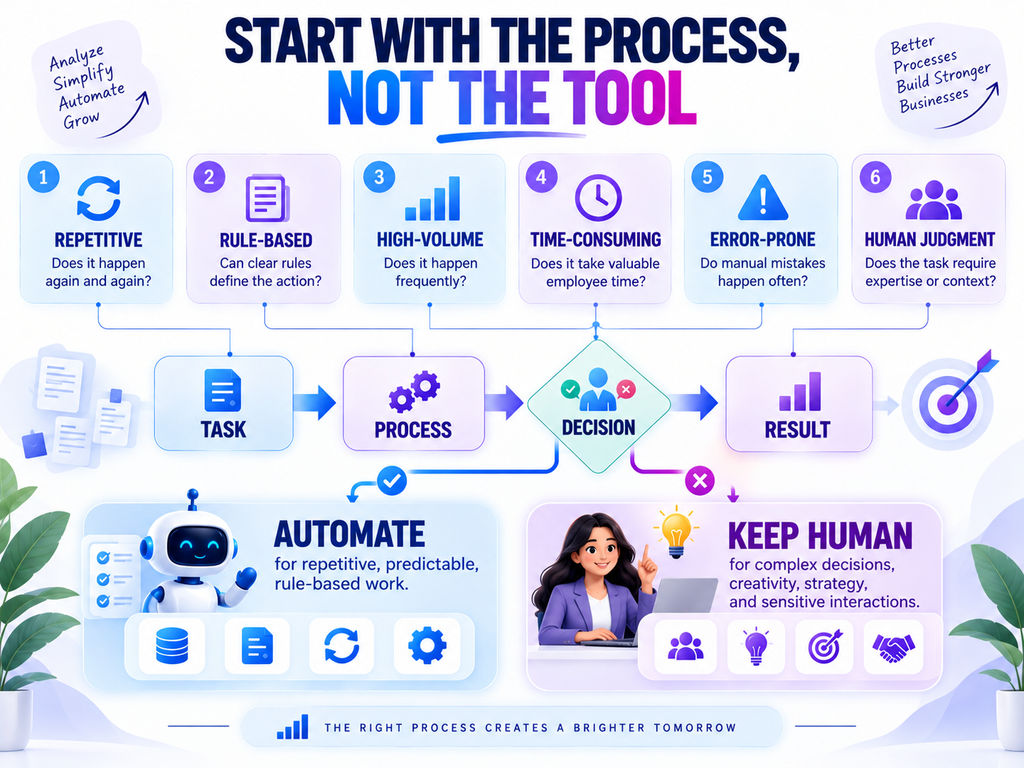
Business Automation Before Hiring: Start With the Process, Not the Tool
A common mistake is purchasing automation software before understanding the business process.
Technology cannot fix a poorly designed workflow by itself.
Before automating anything, document how the process currently works.
Ask:
- What starts the process?
- Who performs each step?
- Which steps are repetitive?
- Which decisions follow fixed rules?
- Where do delays occur?
- Where do errors happen?
- Which systems are involved?
- Which steps genuinely require human judgment?
- How frequently does the process occur?
- What does the process cost in employee time?
Once these questions are answered, it becomes easier to identify the right automation opportunities.
Look for High-Volume, Rule-Based Work
The best early candidates are generally tasks that are:
- Repetitive
- Predictable
- High-volume
- Time-consuming
- Rule-based
- Prone to manual errors
- Spread across multiple systems
For instance, automatically generating a weekly internal report may be a better automation opportunity than trying to automate complex strategic decision-making.
The goal is not maximum automation.
The goal is maximum useful automation.
The Hidden Cost of Manual Work
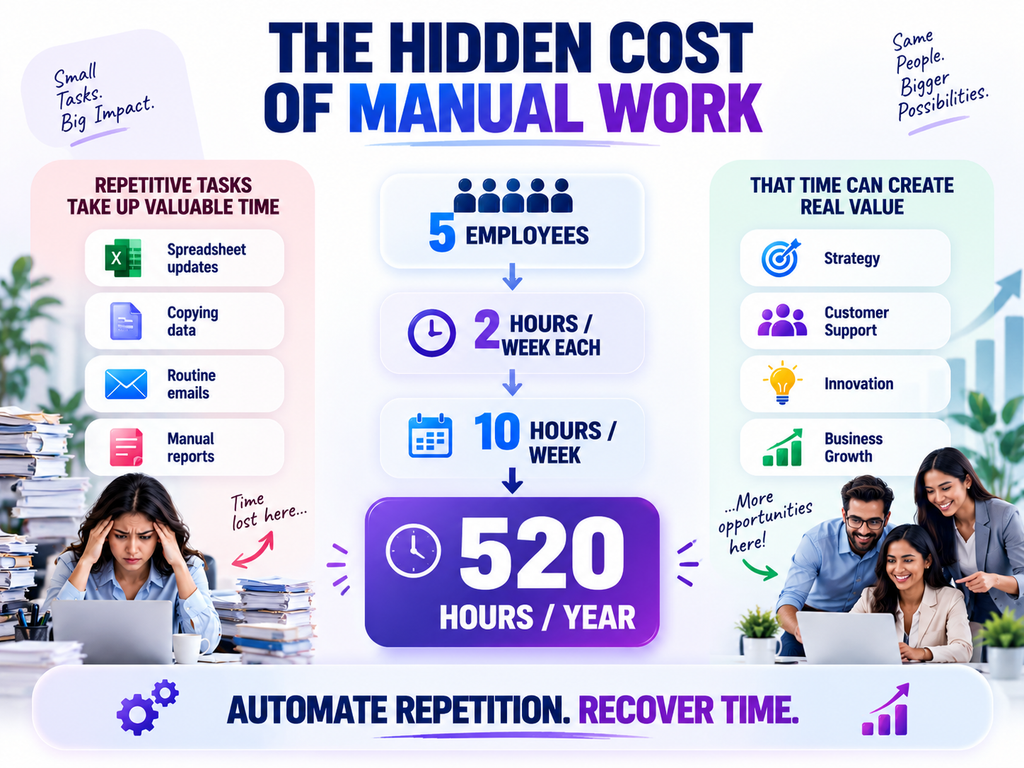
Businesses often calculate the cost of an employee’s salary but overlook the cost of inefficient processes.
Consider a team of five employees where each person spends two hours every week on repetitive administrative work.
That represents:
5 employees × 2 hours = 10 hours per week
Over a year, that becomes approximately:
10 hours × 52 weeks = 520 hours
That is more than 12 full-time workweeks spent on repetitive activity.
Now consider what happens when the business grows.
If the company doubles its workload and responds only by hiring more employees, the same inefficiency gets multiplied.
Automation can change that equation.
Instead of allowing operational costs to increase linearly with workload, businesses can use technology to absorb some of the additional volume.
This is one reason business automation before hiring can be a powerful scalability strategy.
Automation Can Improve Consistency and Reduce Human Error
Manual processes do not just consume time. They can also introduce inconsistencies.
Employees can:
- Enter incorrect information
- Forget routine steps
- Send the wrong document
- Miss a notification
- Update one system but forget another
- Use outdated templates
- Make calculation mistakes
These errors become more expensive as a company grows.
A well-designed automated workflow can apply the same rules every time.
For example, an automated process could verify that required information exists before allowing a record to move to the next stage. Another workflow could automatically create an audit log whenever a critical action occurs.
This creates consistency while also making processes easier to monitor.
For security-sensitive workflows, however, automation must include appropriate access controls, authentication, logging, and monitoring. Organizations can also use established security guidance from resources such as the National Institute of Standards and Technology (NIST) when designing technology processes.
Not Everything Should Be Automated
The phrase automate before you hire should not be interpreted as “automate everything.”
Some activities are better handled by people.
Human involvement remains particularly important when a process involves:
- Complex decision-making
- Sensitive customer interactions
- Strategic planning
- Creative work
- Negotiation
- Conflict resolution
- Ambiguous situations
- High-impact business decisions
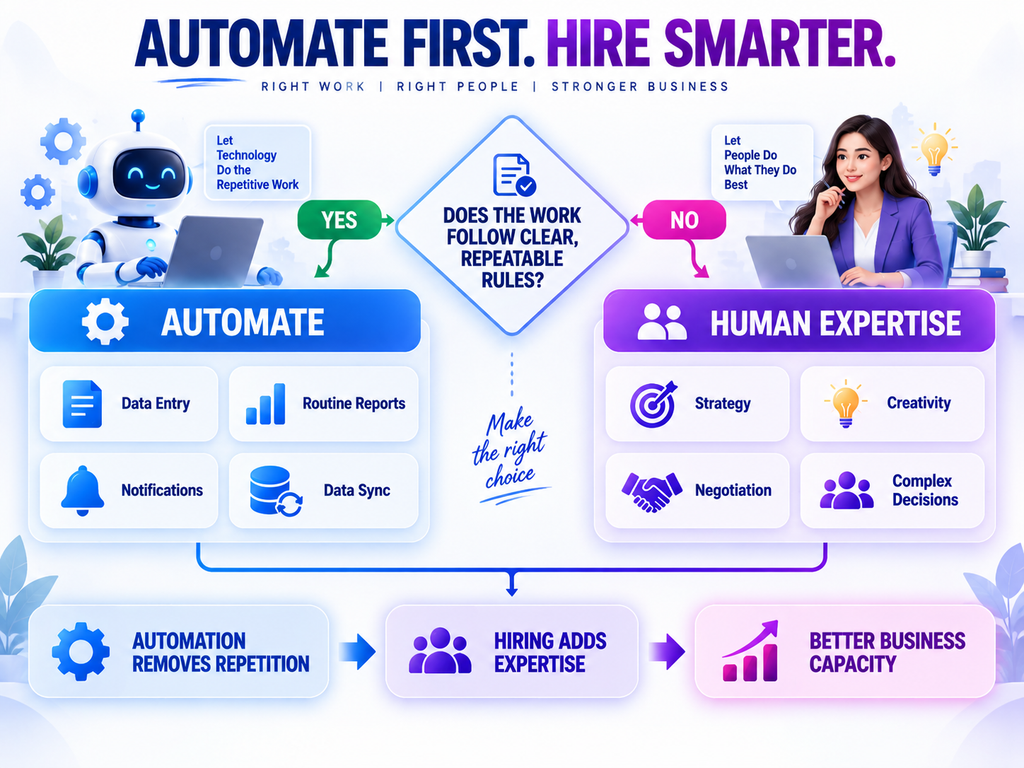
A useful approach is to divide a workflow into three categories:
Fully Automatable
These are predictable tasks that can follow clearly defined rules.
Examples include:
- Scheduled reports
- Data synchronization
- Routine notifications
- File organization
- Basic calculations
Partially Automatable
Technology can handle the repetitive portion, while employees handle exceptions.
Examples include:
- Customer support triage
- Invoice processing
- Lead qualification
- Document review
- Approval workflows
Human-Led
These processes depend heavily on context, judgment, or interpersonal skills.
Examples include:
- Business negotiations
- Leadership decisions
- Strategic planning
- Complex customer relationships
- Creative direction
This model helps businesses use automation as a support system rather than treating it as a replacement for people.
How Automation Changes Hiring Decisions
One of the most important benefits of automation is that it can make hiring decisions more strategic.
Without automation, a manager might say:
“We have too much work. We need another employee.”
After analyzing the workflow, the same manager might discover:
“40% of this workload is repetitive and can be streamlined. We need to automate that portion first, then determine what capabilities are still missing.”
That is a much stronger hiring decision.
Hire for Skills, Not Just Volume
After automation removes repetitive work, the remaining workload can reveal what the business actually needs.
Perhaps the company does not need another general administrator.
Instead, it may need:
- A customer success specialist
- A data analyst
- A cybersecurity professional
- A software developer
- A sales specialist
- A project manager
Automation can therefore improve the quality of hiring, not simply reduce the number of hires.
A Practical Framework for Automating Before Hiring
Businesses can use a simple five-step framework.
Step 1: Identify the Bottleneck
Start with the work creating the greatest operational pressure.
Look for tasks that consume significant employee time or repeatedly delay customers and internal teams.
Step 2: Measure the Current Cost
Calculate:
- Hours spent
- Number of employees involved
- Frequency of the task
- Error rate
- Average processing time
- Business impact of delays
This provides a baseline.
Step 3: Determine What Can Be Automated
Separate the process into individual actions.
Do not try to automate the entire workflow immediately.
Instead, identify specific steps that software can reliably handle.
Step 4: Test the Workflow
Start with a small implementation.
Measure whether the automation actually produces improvements in:
- Processing time
- Accuracy
- Employee productivity
- Customer experience
- Operating cost
Step 5: Reassess the Hiring Requirement
Only after the workflow has been improved should the business determine whether another employee is still necessary.
This final step is critical.
Automation should support better workforce planning, not simply become another technology project.
Automation Is Most Valuable When Systems Work Together
Businesses often use multiple applications for different functions.
For example:
- CRM for customer information
- Accounting software for finances
- Helpdesk software for support
- HR software for employees
- Project management software for operations
- Email platforms for communication
The problem appears when employees repeatedly move information between these systems manually.
Integrations and workflow automation can reduce that unnecessary work.
For example:
New customer created → CRM updated → Welcome email sent → Internal notification created → Customer onboarding task assigned
Instead of requiring several manual actions, a connected workflow can coordinate them.
For organizations looking to strengthen their overall technology practices, the Botdef blog can also serve as a useful resource for security-related technology insights while evaluating how automation affects business operations.
Security Must Be Part of Business Automation
Automation creates efficiency, but it can also introduce new risks if it is poorly designed.
An automated workflow may have access to:
- Customer information
- Internal documents
- Employee records
- Financial data
- Business applications
- Email systems
- Databases
Therefore, every automation should be evaluated from a security perspective.
Businesses should consider:
Access Control
Give automated systems only the permissions they actually require.
Authentication
Protect integrations, APIs, and service accounts using appropriate authentication methods.
Monitoring
Keep useful logs so suspicious or unexpected activity can be identified.
Data Protection
Avoid unnecessarily exposing sensitive information to automation platforms or third-party services.
Failure Handling
Create safeguards for situations where an automated process fails or produces unexpected results.
Automation should make a business more efficient without creating an uncontrolled security gap.
When Should You Actually Hire?
Automation is not a reason to avoid hiring indefinitely.
There are situations where hiring is clearly the better choice.
Consider hiring when:
- Demand has grown beyond the capacity of automated workflows.
- The business requires specialized expertise.
- Customers need more human interaction.
- Strategic responsibilities are increasing.
- Automation has already removed unnecessary manual work.
- The workload requires decisions that technology cannot reliably make.
- Growth is creating genuinely new responsibilities rather than simply more repetitive tasks.
The best organizations do both.
They automate repetitive work and hire people for responsibilities where people create the greatest value.
The Future Is Not Automation vs. Employees
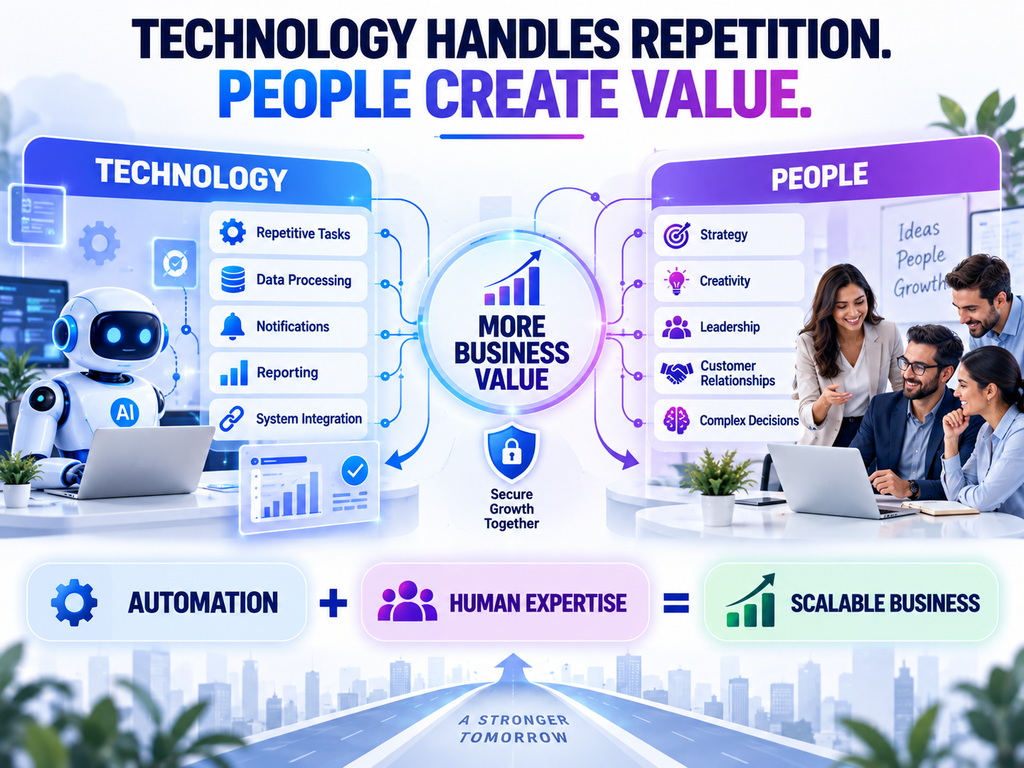
The most productive businesses are unlikely to choose between technology and people.
Instead, they will build systems where the two complement each other.
Technology can handle speed, repetition, consistency, calculations, and predictable workflows.
People can handle creativity, empathy, strategy, leadership, relationships, and complex decisions.
This creates a more effective operating model:
Technology handles repetition → People handle judgment → Business creates more value
That is the real purpose of business automation before hiring.
It is not simply about saving money.
It is about designing a business where every employee can spend more time doing work that matters.
A Simple Example: From Manual Workflow to Scalable Process
Consider a growing service business receiving hundreds of customer requests every week.
Initially, employees manually:
- Read every request.
- Categorize it.
- Enter information into a spreadsheet.
- Notify the appropriate team.
- Send a confirmation.
- Track the request manually.
As volume increases, management considers hiring two additional employees.
Before hiring, the company analyzes the process.
It discovers that categorization follows predictable rules and that confirmations use standardized information.
The company automates those steps.
The new workflow becomes:
Customer request → Automatic categorization → Record creation → Team notification → Confirmation → Human handling of complex cases
The business may still need additional employees later.
However, those employees will now spend their time solving customer problems rather than performing repetitive administrative tasks.
That is a far more scalable approach.
How to Know If Your Business Is Ready for Automation
Your business may be a strong candidate for automation if employees frequently say:
“I do this task every day.”
Other warning signs include:
- Employees constantly updating spreadsheets.
- The same information is entered into multiple systems.
- Routine emails are written repeatedly.
- Reports are manually compiled.
- Approvals are tracked through messages.
- Employees spend significant time searching for information.
- Simple tasks require several disconnected applications.
- Management keeps considering additional hires for the same repetitive workload.
These signals indicate that the problem may not be a lack of employees.
It may be an inefficient process.
The Strategic Advantage of Automating Before Hiring
The biggest advantage of business automation before hiring is not necessarily reducing headcount.
It is gaining clarity.
Automation forces organizations to examine how work actually moves through the business.
That examination can reveal:
- Unnecessary steps
- Duplicate work
- Process bottlenecks
- Security weaknesses
- Communication gaps
- Poor system integration
- Unclear responsibilities
- Opportunities for better employee utilization
Once those problems are visible, leadership can make better technology and hiring decisions.
The result is a business that grows intentionally rather than simply adding people whenever workload increases.
Conclusion: Automate the Repetition, Hire for the Value
Smart businesses do not automatically hire whenever workloads increase.
- They first examine the process.
They ask which tasks can be simplified, integrated, or automated. They measure the cost of manual work, improve inefficient workflows, and then identify where human expertise is genuinely needed.
That is why business automation before hiring is becoming an important strategy for modern organizations.
Automation can increase capacity, improve consistency, reduce repetitive work, and provide employees with more time for meaningful responsibilities. At the same time, thoughtful hiring remains essential when a business needs new expertise, stronger customer relationships, leadership, creativity, or strategic capabilities.
The smartest approach is not people versus technology.
It is:
Automate what technology can reliably handle. Hire for what humans do best.
When businesses follow that principle, technology becomes more than a cost-saving mechanism. It becomes a foundation for sustainable growth, stronger operations, and a workforce focused on higher-value work.
For businesses evaluating automation from both an efficiency and security perspective, continuing to explore trusted technology and security guidance through Botdef’s security resources can help support more informed modernization decisions.