In today’s digital world, staying secure isn’t just an option—it’s a necessity. As cyber threats continue to evolve, organizations of every size must prioritize security to protect their operations, customers, and long-term business value. At BotDef, we regularly share practical cybersecurity insights through our resources to help businesses understand emerging risks and build stronger security strategies.
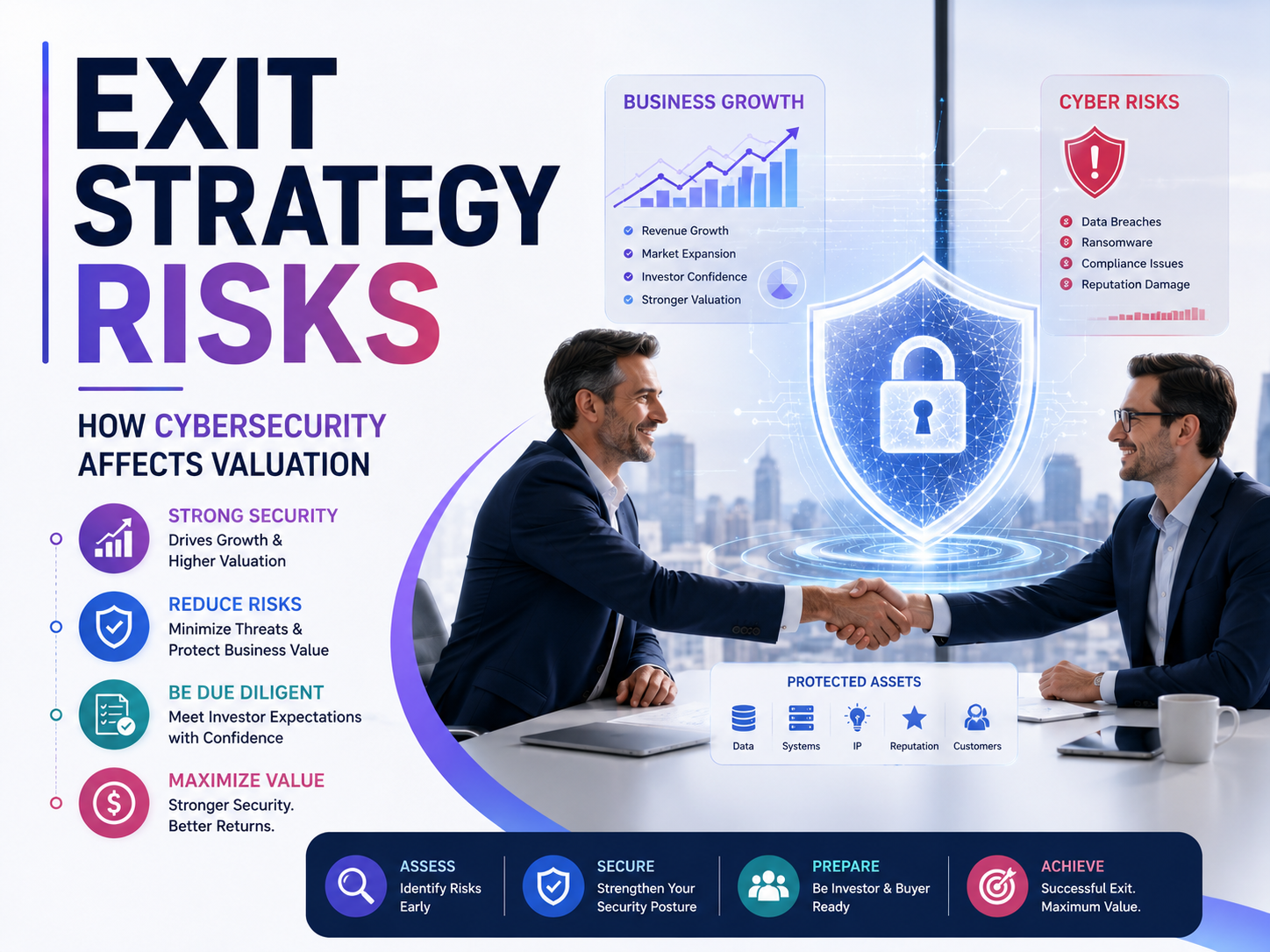
Exit Strategy Risks: How Cybersecurity Affects Valuation
Introduction
Every business owner eventually thinks about an exit strategy. Whether it’s selling the company, attracting private equity investment, merging with another organization, or preparing for an IPO, one question always dominates the conversation:
What is the company worth?
Revenue growth, customer acquisition, recurring income, intellectual property, and market position all influence valuation. However, one factor has become increasingly important over the past decade—and many organizations still underestimate it.
Cybersecurity.
Today’s investors and buyers don’t simply purchase products or revenue streams. They also inherit digital infrastructure, customer data, operational systems, software assets, third-party integrations, and compliance responsibilities. As a result, exit strategy risks are no longer limited to financial statements or legal liabilities. Cybersecurity has become a major component of due diligence, directly influencing acquisition pricing, negotiations, and even whether a deal closes.
A weak security posture can significantly reduce business valuation, delay acquisitions, or completely derail transactions. Conversely, organizations that demonstrate mature cybersecurity practices often command greater confidence, stronger valuations, and smoother exits.
This article explores how cybersecurity affects valuation, why investors increasingly prioritize digital risk assessments, and what organizations can do to strengthen their position before pursuing an exit.
Why Cybersecurity Has Become a Valuation Factor
Several years ago, cybersecurity discussions mainly focused on IT departments.
Today, cybersecurity is a boardroom issue.
According to guidance published by the U.S. Cybersecurity and Infrastructure Security Agency (CISA) and the National Institute of Standards and Technology (NIST), cybersecurity directly impacts operational resilience, regulatory compliance, and organizational risk management.
Modern businesses store enormous volumes of:
- Customer information
- Employee records
- Financial data
- Intellectual property
- Source code
- Cloud infrastructure
- Vendor integrations
- Business analytics
These digital assets often represent some of the company’s most valuable resources.
If they are compromised, the consequences extend far beyond IT.
Potential impacts include:
- Revenue loss
- Customer churn
- Legal action
- Regulatory penalties
- Brand damage
- Operational downtime
- Investor uncertainty
Naturally, buyers account for these risks when determining acquisition value.
How Cybersecurity Affects Valuation
Understanding how cybersecurity affects valuation begins with recognizing that buyers evaluate future risk—not only current performance.
If cybersecurity introduces uncertainty, buyers typically reduce purchase offers accordingly.
Buyers Are Purchasing Future Stability
Acquirers want confidence that operations can continue without significant disruption after closing.
Questions often include:
- Can systems withstand modern attacks?
- Are backups reliable?
- Has the company experienced ransomware?
- How mature are security policies?
- Is customer data adequately protected?
Each unanswered question increases perceived risk.
Security Incidents Reduce Buyer Confidence
Imagine two software companies generating identical revenue.
Company A demonstrates:
- Security certifications
- Regular penetration testing
- Multi-factor authentication
- Continuous monitoring
- Incident response planning
Company B lacks documentation, has outdated infrastructure, and cannot explain previous security incidents.
Even with identical financial performance, investors rarely value both companies equally.
Cybersecurity maturity reduces uncertainty.
Uncertainty affects valuation.
Cybersecurity Due Diligence During Mergers and Acquisitions
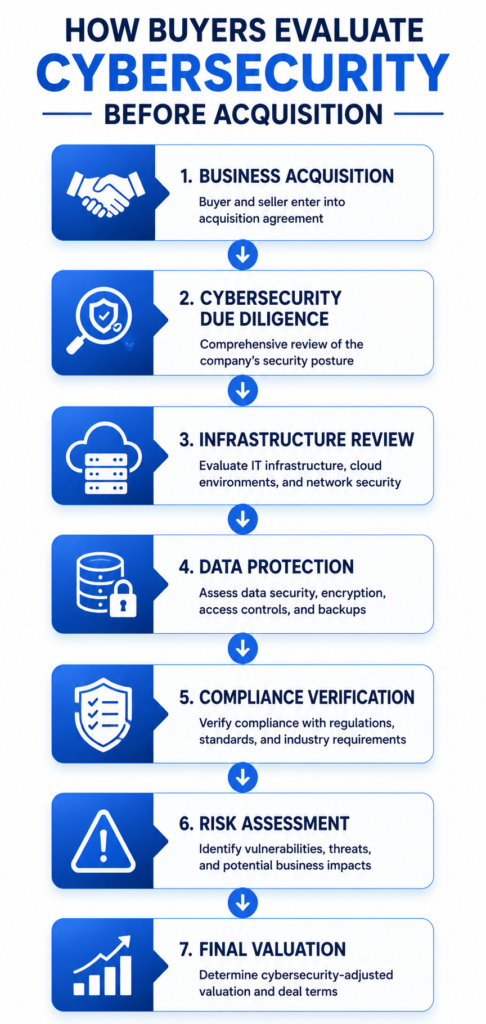
Cyber due diligence has become a standard component of modern M&A transactions.
Alongside legal, financial, and operational reviews, buyers now conduct comprehensive cybersecurity assessments.
These reviews often examine:
Infrastructure Security
Buyers assess:
- Cloud environments
- Network architecture
- Identity management
- Server configuration
- Endpoint protection
Data Protection
Organizations are expected to demonstrate:
- Encryption
- Access controls
- Secure backups
- Data retention policies
- Privacy compliance
Compliance
Depending on the industry, reviewers evaluate compliance with standards such as:
- ISO 27001
- SOC 2
- GDPR
- HIPAA
- PCI DSS
Failure to comply can create future liabilities.
Incident History
Buyers frequently request:
- Previous breach reports
- Security audit findings
- Penetration testing results
- Vulnerability assessments
- Risk registers
Transparency generally builds trust.
Hidden incidents often destroy it.
For organizations looking to strengthen their overall security posture before major business milestones, the educational resources available on the BotDef Blog provide practical guidance on modern cyber risks, defensive strategies, and security best practices that support long-term resilience.
Common Exit Strategy Risks Related to Cybersecurity
Many organizations unknowingly carry cybersecurity issues that become major obstacles during acquisition.
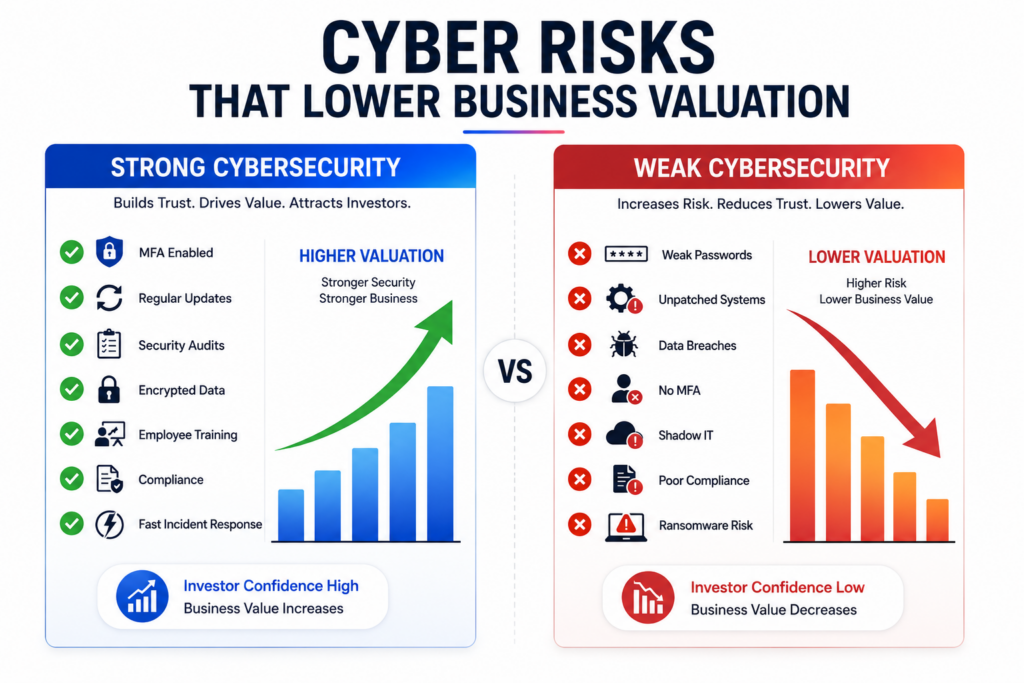
1. Legacy Systems
Outdated operating systems and unsupported software introduce vulnerabilities.
Buyers often calculate future upgrade costs into valuation models.
2. Weak Access Controls
Shared administrator accounts.
Poor password policies.
No multi-factor authentication.
These are significant warning signs.
3. Unpatched Vulnerabilities
Delayed patch management increases exposure to known exploits.
Regular vulnerability management demonstrates operational maturity.
4. Shadow IT
Employees frequently adopt unauthorized applications without security review.
Unknown SaaS applications create compliance and visibility challenges.
5. Third-Party Risk
Suppliers can introduce security weaknesses.
Modern due diligence increasingly evaluates vendor risk management programs.
6. Poor Incident Response
Organizations without documented response plans typically require additional investment after acquisition.
That cost often lowers purchase prices.
7. Limited Security Awareness
Human error remains one of the leading causes of breaches.
Regular employee training significantly reduces organizational risk.
How Cyber Incidents Impact Business Valuation
Security incidents create both immediate and long-term financial consequences.
Revenue Loss
Operational disruptions delay projects and reduce productivity.
Customers may also terminate contracts following a breach.
Legal Expenses
Cyber incidents frequently result in:
- Lawsuits
- Regulatory investigations
- Compliance remediation
- Contract disputes
Reputation Damage
Trust is difficult to rebuild.
Negative publicity often impacts future revenue projections.
Customer Attrition
Enterprise clients increasingly demand strong cybersecurity.
Weak security can influence contract renewals.
Increased Insurance Costs
Cyber insurance providers evaluate organizational maturity.
Poor security controls may increase premiums or reduce coverage.
Acquisition Delays
Security investigations frequently extend transaction timelines.
Extended negotiations increase uncertainty for both parties.
Cybersecurity Metrics That Investors Appreciate
Strong cybersecurity can become a competitive advantage during negotiations.
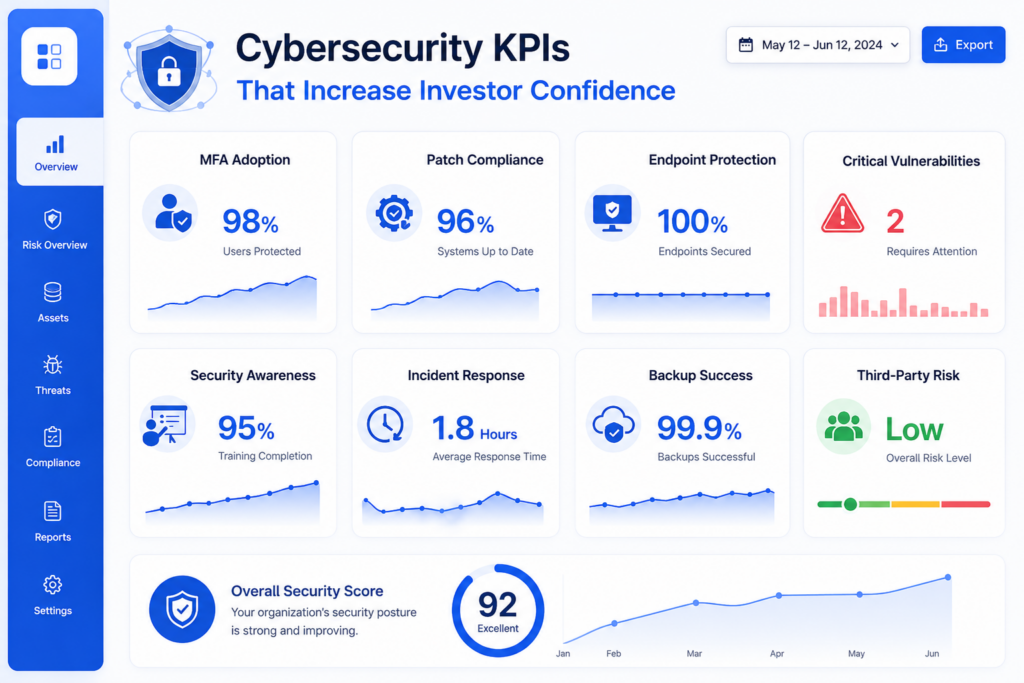
Investors appreciate measurable security improvements such as:
- Multi-factor authentication adoption
- Endpoint detection coverage
- Patch compliance rates
- Security awareness completion rates
- Mean Time to Detect (MTTD)
- Mean Time to Respond (MTTR)
- Backup testing success
- Vulnerability remediation timelines
- Penetration testing frequency
- Third-party risk assessments
Quantifiable metrics create confidence.
Confidence supports valuation.
Building a Security-First Business Before an Exit
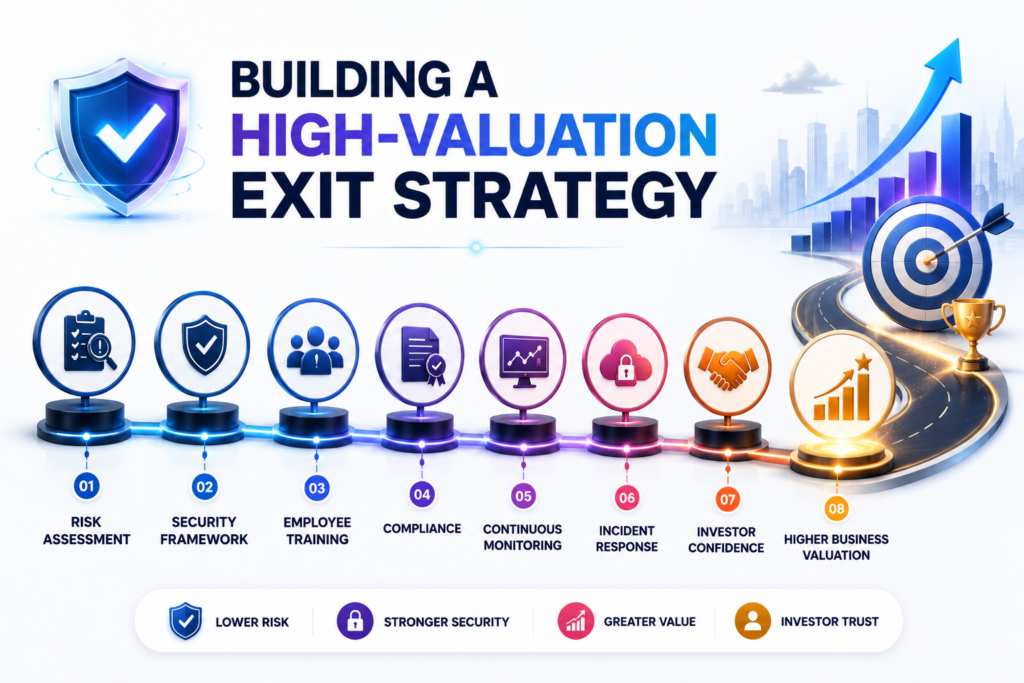
Organizations planning acquisitions years in advance gain significant advantages.
Rather than preparing only months before a transaction, cybersecurity should become an ongoing business investment.
Perform Regular Risk Assessments
Identify:
- Critical assets
- High-risk systems
- Business dependencies
- Threat exposure
Routine assessments demonstrate proactive governance.
Maintain Documentation
Security documentation matters.
Examples include:
- Policies
- Procedures
- Incident response plans
- Asset inventories
- Disaster recovery plans
- Security training records
Well-organized documentation accelerates due diligence.
Conduct Independent Security Audits
Third-party assessments provide objective evidence of security maturity.
Buyers generally trust independent reports more than internal claims.
Adopt Recognized Frameworks
Organizations aligned with recognized frameworks often experience smoother due diligence.
Popular frameworks include:
- NIST Cybersecurity Framework
- CIS Controls
- ISO 27001
Improve Identity Security
Identity remains the new security perimeter.
Best practices include:
- MFA
- Least privilege
- Role-based access
- Identity governance
- Privileged access management
Strengthen Backup and Recovery
Buyers increasingly evaluate resilience.
Organizations should demonstrate:
- Immutable backups
- Recovery testing
- Business continuity planning
- Disaster recovery exercises
Questions Buyers Frequently Ask
During cybersecurity due diligence, expect questions like:
- Have you experienced previous breaches?
- How quickly can critical systems recover?
- Are all devices encrypted?
- How are privileged accounts managed?
- Do employees receive security training?
- How are third-party vendors evaluated?
- Is customer data encrypted?
- Are vulnerabilities regularly scanned?
- What cybersecurity frameworks are followed?
- How is cloud infrastructure protected?
Preparing these answers in advance improves negotiation confidence.
Cybersecurity as a Competitive Advantage
Many organizations still view cybersecurity as an expense.
Forward-thinking businesses treat it as an investment.
Strong cybersecurity helps organizations:
- Increase buyer confidence
- Reduce acquisition friction
- Improve compliance
- Strengthen customer trust
- Protect intellectual property
- Improve operational resilience
- Support higher valuation
As digital transformation accelerates, cybersecurity maturity increasingly differentiates organizations during acquisitions.
Rather than becoming an obstacle, it becomes a selling point.
Organizations seeking practical cybersecurity guidance, educational resources, and strategies to improve their security posture can explore additional insights through BotDef, where cybersecurity awareness and proactive defense remain central to helping businesses navigate an increasingly complex threat landscape.
Conclusion
Every exit strategy involves risk, but cybersecurity is one area that organizations can actively strengthen long before negotiations begin.
Understanding how cybersecurity affects valuation enables business leaders to reduce uncertainty, improve resilience, and demonstrate operational maturity to investors and potential buyers. From implementing stronger access controls to maintaining comprehensive documentation and aligning with recognized frameworks, every security improvement contributes to greater business confidence.
Today’s acquisitions extend beyond financial performance. Buyers evaluate digital assets, operational resilience, compliance readiness, and the organization’s ability to withstand future cyber threats. Businesses that invest consistently in cybersecurity are often better positioned to negotiate favorable terms, avoid costly surprises during due diligence, and protect long-term enterprise value.
Ultimately, cybersecurity is no longer simply an IT responsibility—it is a strategic business asset that directly influences valuation, reputation, and successful exits.