In today’s fast-moving digital economy, startups often face an uphill battle against large enterprises with bigger budgets, larger teams, and extensive operational resources. However, one major advantage has changed the competitive landscape: automation.
Modern automation technologies enable startups to streamline operations, improve security, reduce costs, and deliver exceptional customer experiences without hiring massive teams. Instead of trying to match enterprise-scale resources, startups can leverage smart automation to maximize efficiency and focus on innovation.
At the same time, automation must be implemented securely. Automated systems often process sensitive customer information, connect multiple cloud services, and manage critical business workflows. Organizations that prioritize automation without considering cybersecurity may unintentionally create new attack surfaces.
If you’re interested in learning more about cybersecurity best practices alongside automation strategies, the resources available on the BotDef Security Center provide practical insights into protecting modern digital businesses.
This guide explores how startups can use automation to compete with large enterprises while maintaining strong security, scalability, and operational excellence.
Why Automation Levels the Playing Field for Startups
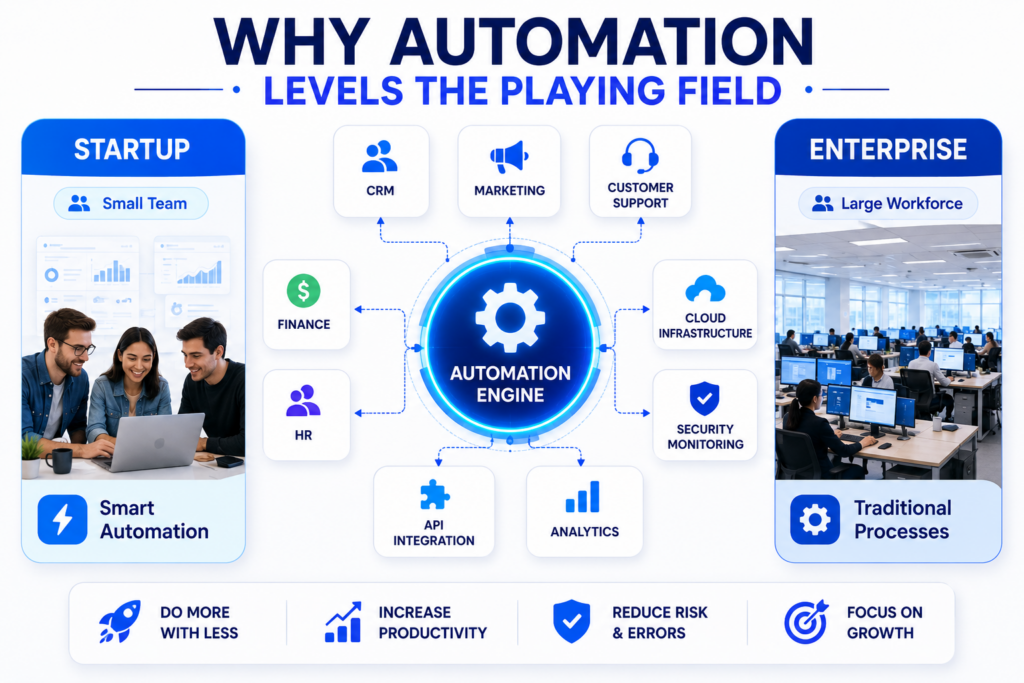
Large enterprises traditionally dominated industries because they could afford:
- Large customer support teams
- Dedicated IT departments
- Extensive marketing teams
- Manual compliance processes
- Enterprise-grade infrastructure
Today, automation significantly reduces these advantages.
Cloud platforms, AI-powered services, workflow automation, infrastructure management, and cybersecurity tools allow startups to achieve similar outcomes using fewer resources.
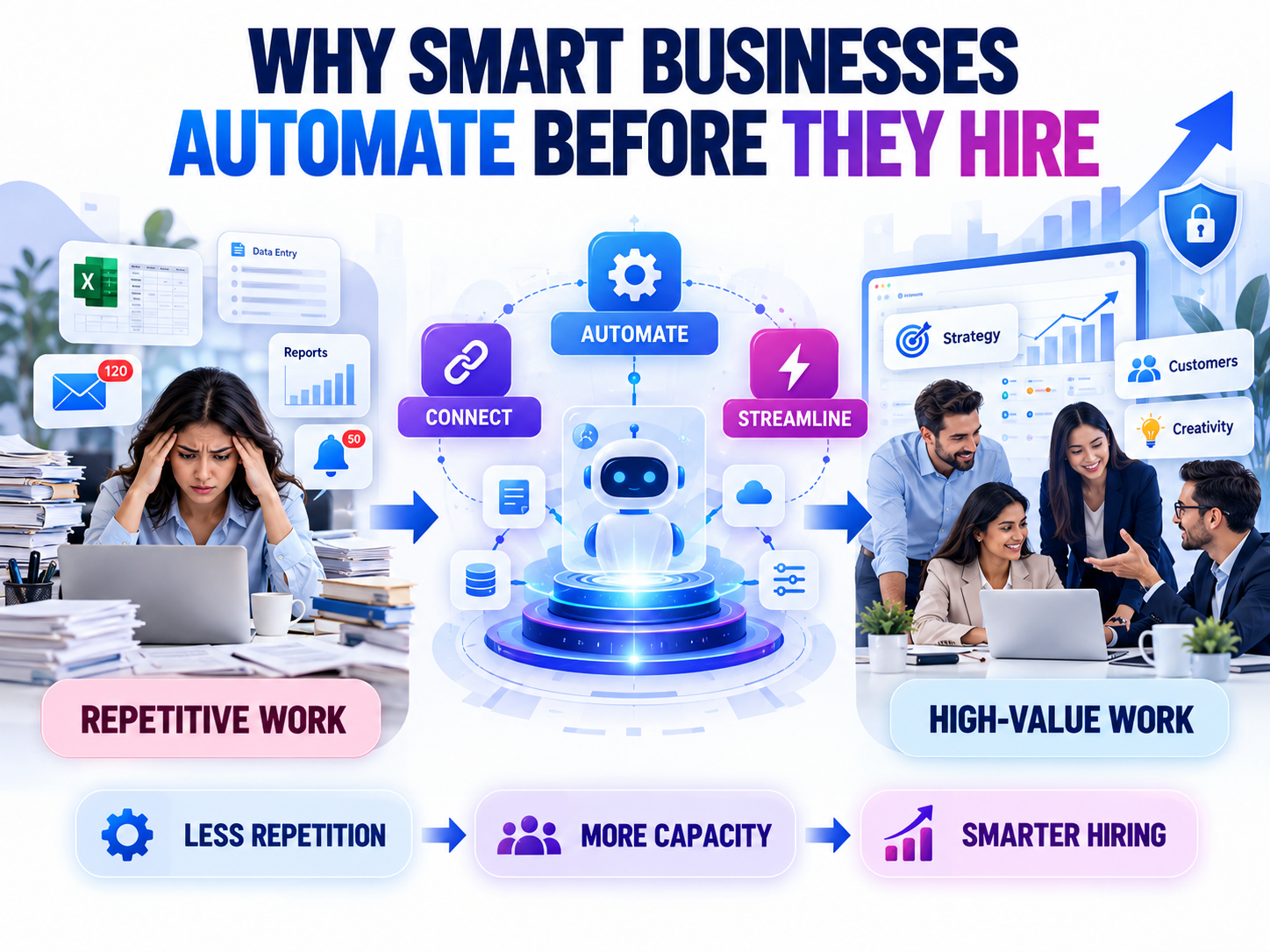
Instead of hiring dozens of employees for repetitive work, startups can automate many routine operations while allowing employees to focus on higher-value activities.
This shift enables smaller organizations to innovate faster and respond more quickly to changing market demands.
How Startups Can Use Automation to Compete with Big Enterprises
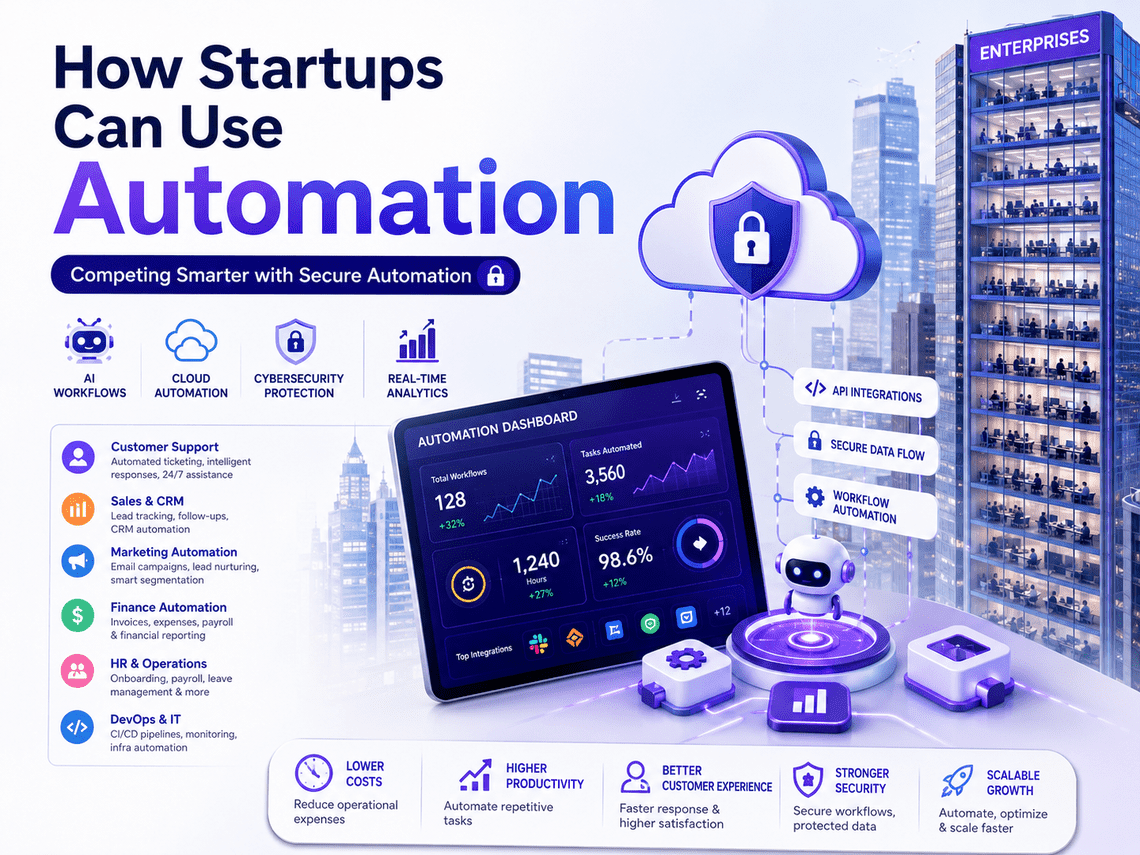
Automation is no longer limited to large corporations. Startups can now automate nearly every business function.
Customer Support
AI-powered chatbots and intelligent ticket routing help businesses:
- Answer common questions instantly
- Route support requests automatically
- Reduce response times
- Improve customer satisfaction
- Provide 24/7 assistance
Human agents can then focus on solving complex customer issues instead of repetitive requests.
Sales and Lead Management
Automation improves sales productivity by handling repetitive administrative tasks.
Examples include:
- Automatic lead qualification
- CRM updates
- Email follow-ups
- Appointment scheduling
- Proposal generation
- Sales pipeline tracking
Sales teams spend more time building relationships and closing deals instead of updating spreadsheets.
Marketing Automation
Marketing automation enables startups to compete with enterprise marketing teams.
Businesses can automate:
- Email campaigns
- Social media publishing
- Customer segmentation
- Landing page testing
- Lead nurturing
- Campaign analytics
These automated workflows improve consistency while saving valuable time.
Financial Operations
Finance teams also benefit significantly from automation.
Examples include:
- Invoice generation
- Expense tracking
- Payment reminders
- Payroll processing
- Financial reporting
- Tax document preparation
Automation reduces manual errors while improving financial visibility.
Human Resources
HR automation simplifies employee management.
Organizations can automate:
- Candidate screening
- Employee onboarding
- Leave management
- Payroll workflows
- Training reminders
- Performance reviews
These improvements allow HR teams to focus more on employee engagement.
Automation Improves Cybersecurity
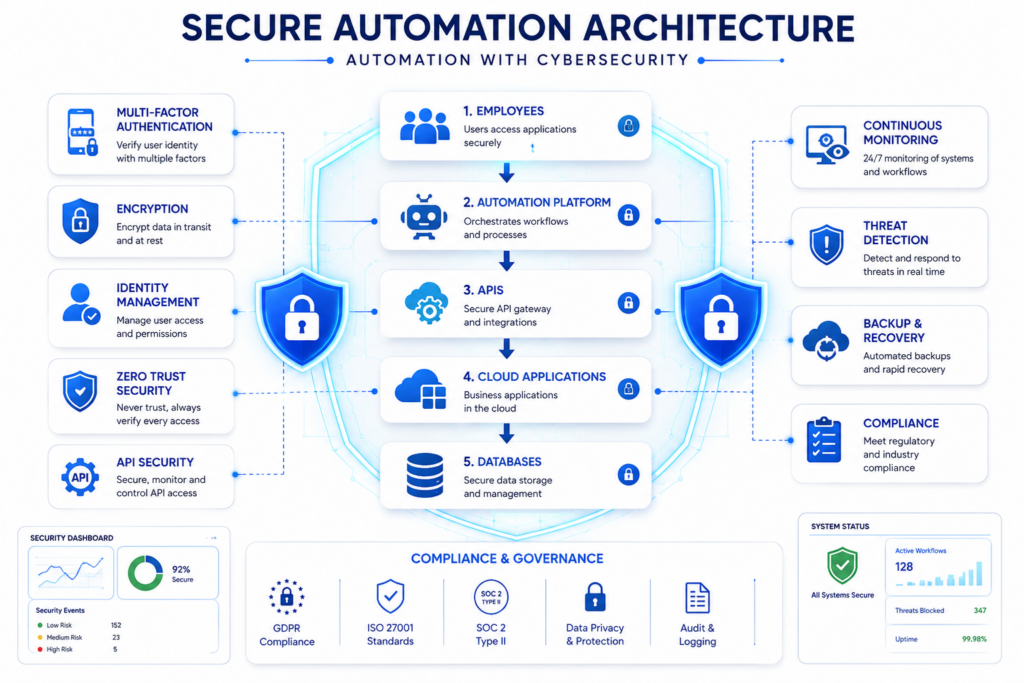
Many organizations associate automation only with productivity. However, automation also strengthens cybersecurity.
Security teams use automation to:
- Detect suspicious activity
- Monitor cloud environments
- Scan systems continuously
- Apply security patches
- Generate compliance reports
- Respond to threats faster
Automated security monitoring significantly reduces response times compared to manual investigations.
According to the NIST Cybersecurity Framework, organizations should continuously monitor systems and automate security processes wherever practical to improve resilience.
Security Risks Every Startup Should Consider
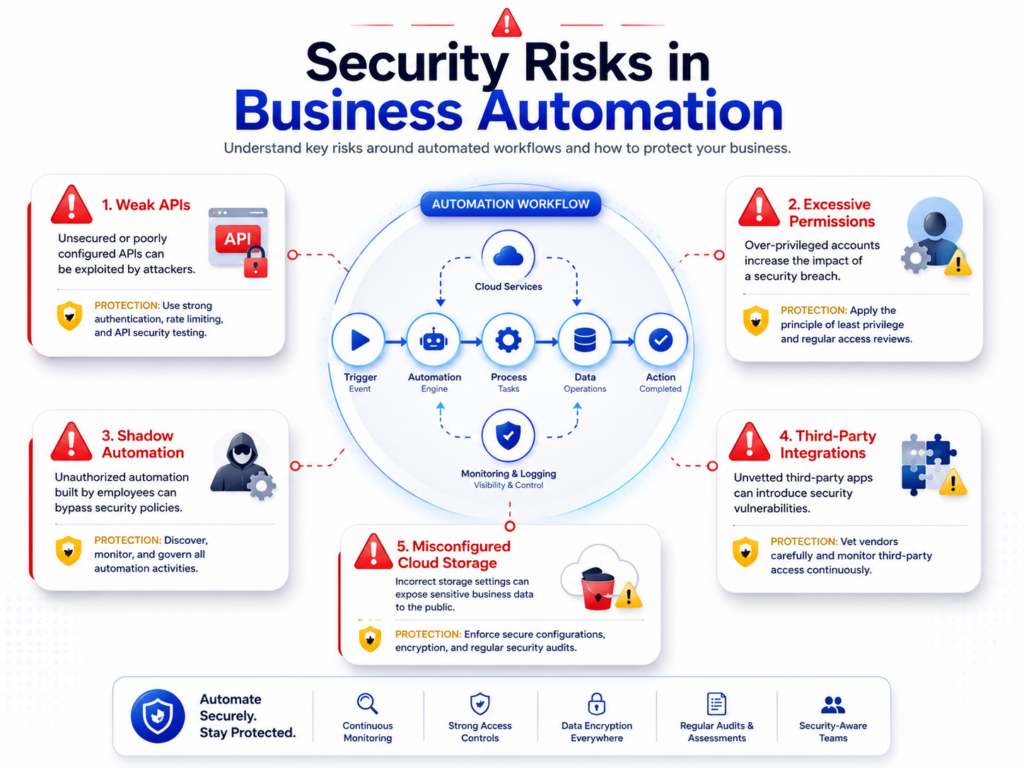
Although automation delivers many advantages, it also introduces new security challenges.
Poorly configured workflows may expose:
- Customer databases
- API credentials
- Cloud storage
- Internal applications
- Authentication tokens
Common risks include:
Weak API Security
Modern automation depends heavily on APIs.
Without proper authentication, attackers may abuse exposed APIs to access sensitive business data.
Excessive Permissions
Automation accounts sometimes receive unnecessary administrative privileges.
Following the Principle of Least Privilege reduces this risk.
Shadow Automation
Employees occasionally create unofficial automated workflows without IT approval.
These “shadow automation” processes may bypass security policies and create hidden vulnerabilities.
Third-Party Integrations
Many automated workflows connect multiple cloud services.
Every additional integration increases the potential attack surface.
Organizations should regularly review connected applications and remove unnecessary access.
Building Secure Automation from Day One
Startups should integrate security into every automation project instead of adding protections later.
Recommended best practices include:
Use Multi-Factor Authentication
Require MFA for:
- Cloud platforms
- Automation tools
- Admin accounts
- Development environments
This prevents unauthorized access even if passwords are compromised.
Encrypt Sensitive Data
Customer information should remain encrypted:
- During storage
- During transmission
- During backups
Encryption significantly reduces the impact of data breaches.
Monitor Automated Workflows
Continuous monitoring helps identify:
- Failed workflows
- Suspicious API activity
- Unauthorized changes
- Unexpected permissions
Regular monitoring allows security teams to respond quickly.
Keep Software Updated
Outdated software remains one of the leading causes of successful cyberattacks.
Automating patch management helps eliminate known vulnerabilities before attackers exploit them.
Automation Across Different Startup Departments
Automation delivers value throughout the organization.
| Department | Example Automation |
|---|---|
| Marketing | Email campaigns, campaign analytics |
| Sales | CRM updates, lead scoring |
| Finance | Billing, invoicing, expense management |
| HR | Recruitment, onboarding |
| IT | User provisioning, backups |
| Security | Threat detection, vulnerability scanning |
| Customer Service | Chatbots, ticket routing |
Choosing the Right Processes to Automate
Not every task should be automated immediately.
Startups should prioritize processes that are:
- Repetitive
- Time-consuming
- Rule-based
- Error-prone
- High volume
- Easy to measure
Examples include:
- Password resets
- Employee onboarding
- Customer onboarding
- Invoice approvals
- Security monitoring
- Cloud backups
Starting with smaller automation projects reduces implementation risks while delivering quick wins.
Measuring Automation Success
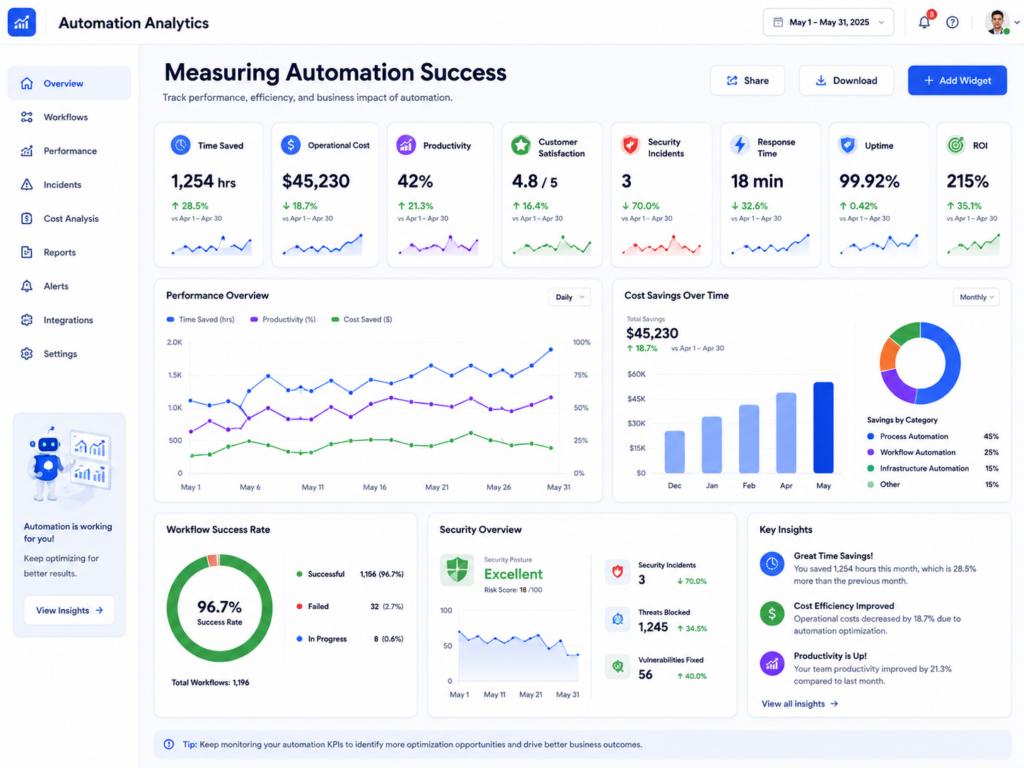
Successful automation should produce measurable business improvements.
Useful metrics include:
- Time saved
- Cost reduction
- Error reduction
- Customer satisfaction
- Employee productivity
- Security incident response time
- Infrastructure uptime
Tracking these metrics helps organizations continually improve their automation strategy.
Future Trends in Business Automation
Automation continues evolving rapidly through artificial intelligence and machine learning.
Emerging trends include:
AI-Powered Decision Support
AI increasingly assists employees by recommending actions rather than replacing human judgment.
Predictive Security
Security platforms now analyze behavioral patterns to identify threats before attacks occur.
The Cybersecurity and Infrastructure Security Agency (CISA) also encourages organizations to adopt proactive security practices that improve resilience against evolving cyber threats.
Autonomous Infrastructure
Cloud infrastructure increasingly manages itself through:
- Automatic scaling
- Self-healing systems
- Predictive maintenance
- Automated resource optimization
These technologies reduce operational overhead for startups.
Automation Is Most Effective When Combined with Strong Cybersecurity
Automation alone cannot create a competitive advantage if security is overlooked.
Every automated workflow should include:
- Identity verification
- Access control
- Continuous monitoring
- Audit logging
- Data encryption
- Backup and recovery planning
Businesses that combine automation with cybersecurity create more resilient digital operations while protecting customer trust.
Readers interested in additional cybersecurity guidance can explore the BotDef Blog for practical articles covering emerging threats, security best practices, and technology trends relevant to growing businesses.
Conclusion
How startups can use automation to compete with big enterprises is no longer a theoretical discussion—it is a practical strategy that enables smaller organizations to operate with greater speed, efficiency, and agility. By automating repetitive tasks across customer service, marketing, finance, HR, IT, and security, startups can deliver enterprise-level experiences while keeping operational costs under control.
However, automation should always be paired with a strong cybersecurity foundation. Secure APIs, continuous monitoring, least-privilege access, encryption, and regular security updates help ensure that automation accelerates growth without introducing unnecessary risk.
As automation technologies continue to evolve, startups that invest in secure, scalable automation today will be better positioned to innovate, adapt, and compete in an increasingly digital marketplace. For more practical insights into securing modern business environments, explore the cybersecurity resources available at BotDef Insights, where you’ll find guidance on protecting automated systems and strengthening your overall security posture.