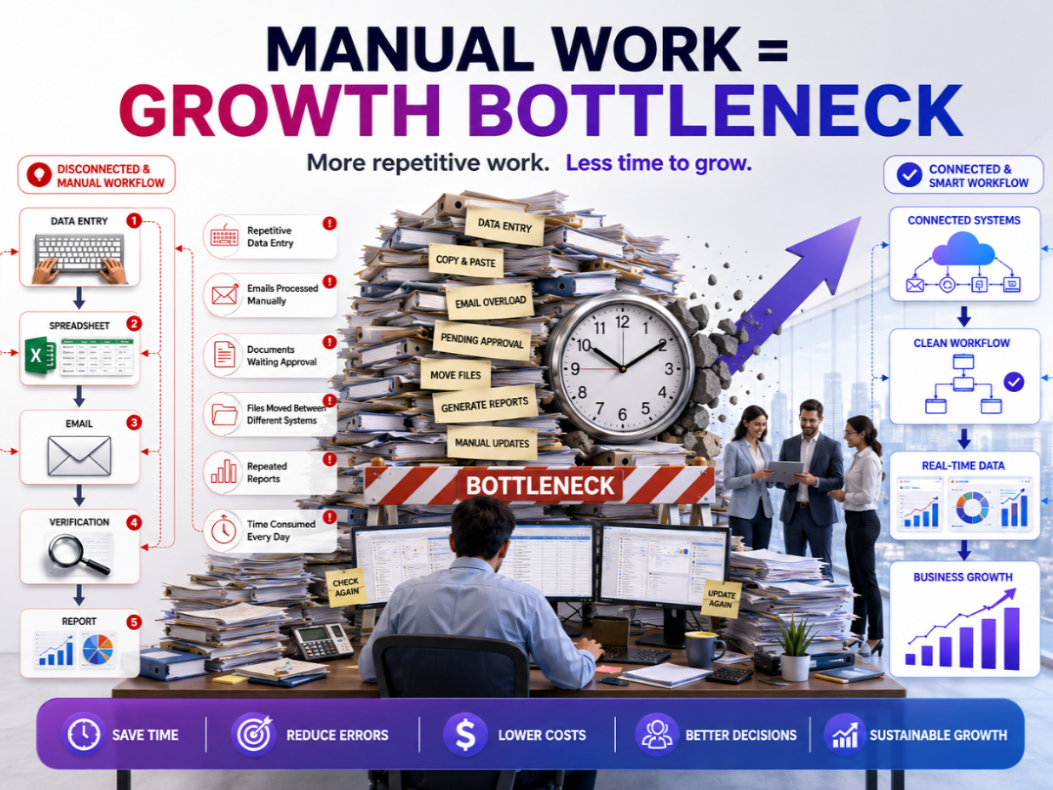
Business growth is often associated with bigger teams, more customers, better marketing, and stronger technology. However, there is another factor that quietly determines how quickly a business can scale: manual work.
Every business has repetitive tasks. Employees copy information from one system to another, prepare reports, update spreadsheets, respond to routine requests, verify records, organize files, follow up with customers, and perform countless administrative activities. Individually, these tasks may seem harmless. Collectively, they can become one of the biggest barriers to productivity and growth.
The real problem is not that employees perform manual tasks. The problem begins when a business continues relying on manual processes even after those processes have become too large, repetitive, or error-prone to manage efficiently.
This is why manual work and business growth are closely connected. When too much operational time is consumed by repetitive activities, teams have less time for innovation, customer service, strategic planning, and revenue-generating work.
For organizations that also manage sensitive information, reducing unnecessary manual processes can have an additional benefit: fewer opportunities for human error and inconsistent handling of data. Resources such as the NIST Cybersecurity Framework provide useful guidance for organizations looking to strengthen their overall approach to managing technology and operational risk.
The important question, therefore, is not simply, “How much manual work do we have?”
It is:
“How much business growth are we losing because of it?”
What Is Manual Work in a Business?
Manual work refers to tasks that require people to repeatedly perform actions that could potentially be standardized, streamlined, or supported by technology.
It can appear in almost every department.
For example:
- Sales teams manually update customer information.
- Marketing teams compile campaign reports from multiple platforms.
- Finance teams enter invoices into spreadsheets.
- HR teams process employee information manually.
- Operations teams repeatedly transfer data between applications.
- IT teams manually check routine system activities.
- Customer support teams answer the same basic questions repeatedly.
- Managers manually create reports from different data sources.
Not every manual task is unnecessary. Some activities require human judgment, creativity, communication, or decision-making.
The problem is repetitive manual work that consumes valuable human attention without creating proportional business value.
A five-minute task may not seem significant. But when 20 employees perform that task several times every day, the accumulated cost can become substantial.
Why Manual Work Becomes a Growth Problem
Manual work rarely appears as a major business problem overnight.
Instead, it grows gradually.
A company may start with a spreadsheet because it has only a few customers. Later, another spreadsheet is introduced for reporting. Then employees begin maintaining separate documents for operations, sales, finance, and customer information.
Eventually, employees spend more time managing the process than actually improving it.
This creates a hidden operational tax.
The productivity tax
Suppose an employee spends 90 minutes each working day performing repetitive administrative tasks.
That equals approximately:
- 7.5 hours per week
- 30 hours per month
- 360 hours per year
Now multiply that across a team.
If ten employees lose the same amount of time, the organization could be spending thousands of working hours every year on activities that may offer limited strategic value.
The financial cost is only one part of the problem.
The bigger cost can be the opportunities employees never have time to pursue.
The Hidden Costs of Manual Work
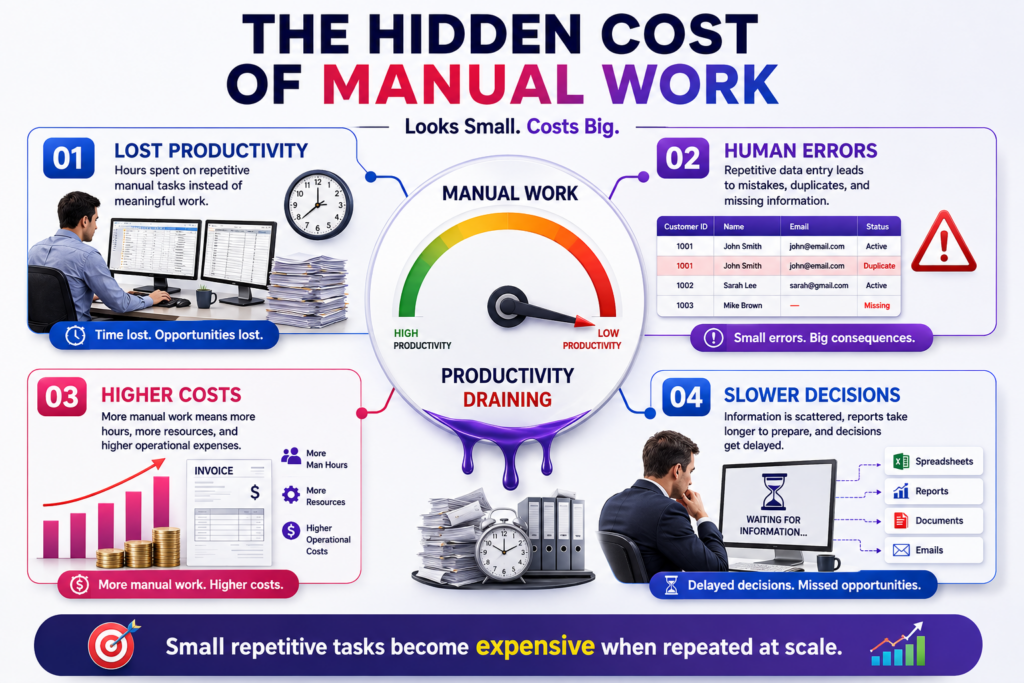
Manual work affects more than productivity. It can influence accuracy, employee experience, customer satisfaction, operational security, and scalability.
1. Lost Productivity
The most obvious problem is time.
Employees who spend hours copying information, checking records, preparing repetitive reports, or moving data between systems have less time available for meaningful work.
A sales representative, for example, could spend more time speaking with qualified prospects instead of manually maintaining multiple spreadsheets.
Similarly, a developer could spend more time improving a product instead of repeatedly performing routine administrative checks.
Productivity improves when people can focus on tasks that actually require human expertise.
2. Increased Human Error
Manual processes depend heavily on consistency and attention.
Unfortunately, humans make mistakes.
A single incorrect character in an email address, an outdated spreadsheet value, a duplicated customer record, or an incorrectly entered financial figure can create additional work.
The consequences can become more serious when manual errors affect sensitive or business-critical information.
According to IBM’s Cost of a Data Breach research, data breaches can create significant financial and operational consequences for organizations. While not every manual error becomes a security incident, reducing unnecessary handling of sensitive information is an important part of building more controlled processes.
3. Higher Operational Costs
Manual processes require people.
As business volume increases, companies often respond by adding more employees to handle growing workloads.
At first, this approach may work.
However, it can eventually create a cycle:
More customers → more work → more employees → more processes → more management complexity.
Technology can help break this cycle by allowing businesses to increase output without increasing manual effort at the same rate.
This does not mean replacing people.
Instead, it means allowing people to spend their time where human contribution matters most.
4. Slower Decision-Making
Business decisions depend on reliable information.
When information is spread across spreadsheets, emails, documents, and different systems, employees may need significant time to collect and verify it before making a decision.
That delay matters.
Markets change quickly. Customer expectations change quickly. Competitors launch new products quickly.
If a company needs several days to prepare information that could otherwise be available within minutes, it becomes harder to respond at the same speed as the market.
Manual Work and Business Growth: The Connection
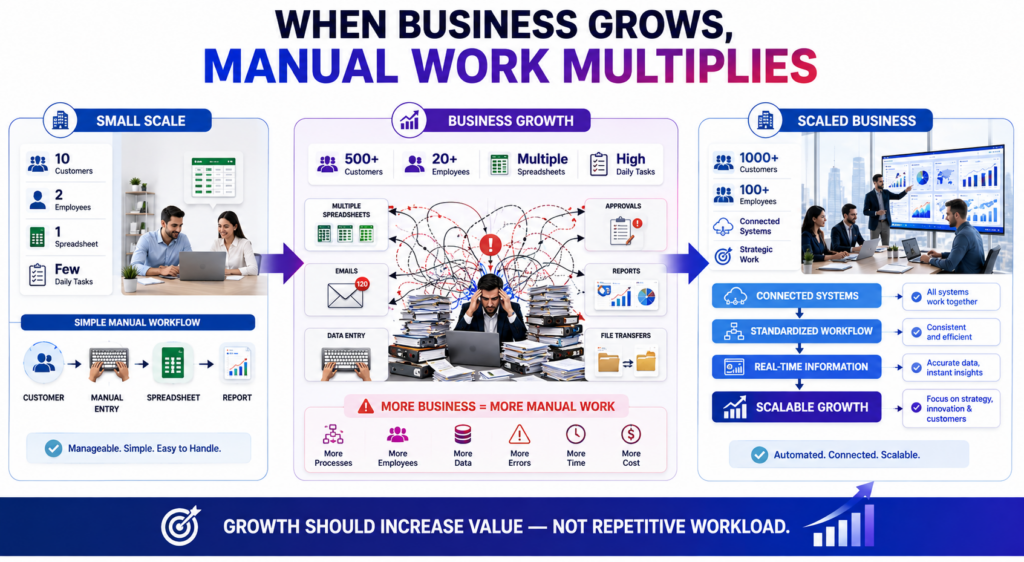
The relationship between manual work and business growth becomes especially clear when a company begins scaling.
A process that works for 100 customers may not work for 10,000 customers.
A reporting process that takes 30 minutes per week may become a major operational burden when the number of data sources increases.
A support workflow that works for five employees may become difficult to manage when the organization reaches 100 employees.
This is known as a scalability problem.
Growth multiplies inefficient processes
One of the most dangerous characteristics of manual work is that it often scales linearly with business volume.
If every new customer requires another set of manual steps, workload increases alongside revenue.
That means the business may grow without becoming significantly more efficient.
A healthy growth model should ideally allow revenue and customer volume to increase faster than repetitive operational effort.
This is where process improvement and technology become strategic rather than optional.
Why Employees Become Frustrated by Repetitive Work
Manual work is not only a technology problem.
It is also a people problem.
Employees generally want to feel that their time and skills are being used effectively. When highly capable people spend a large portion of their day performing repetitive tasks, frustration can build.
Common signs include:
- Employees complaining about repetitive administrative work
- Increased dependency on spreadsheets
- Frequent requests to “fix” or “check” the same information
- Employees staying late to complete routine tasks
- Higher error rates toward the end of the workday
- Difficulty keeping processes consistent
- Teams creating their own unofficial workflows
Over time, these issues can affect morale and employee retention.
Reducing repetitive work can therefore improve both operational efficiency and the employee experience.
The Difference Between Manual Work and Human Work
It is important to make one distinction.
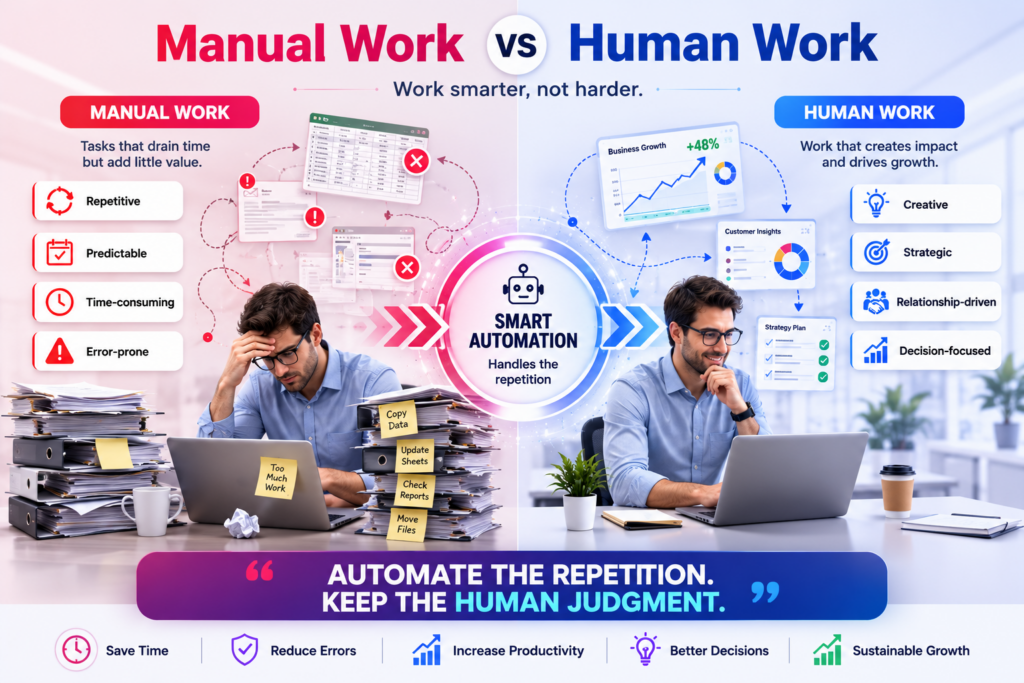
Manual work is not the same as human work.
Human work includes activities such as:
- Building relationships
- Solving complex problems
- Designing products
- Negotiating with customers
- Making strategic decisions
- Understanding customer needs
- Creating new ideas
- Managing people
These activities depend on judgment, experience, creativity, and empathy.
Manual work, on the other hand, often consists of predictable steps.
For example, a person may need to manually move a customer record from one spreadsheet to another. The decision about how to serve that customer may require human intelligence, but copying the record may not.
The goal should not be to eliminate human involvement.
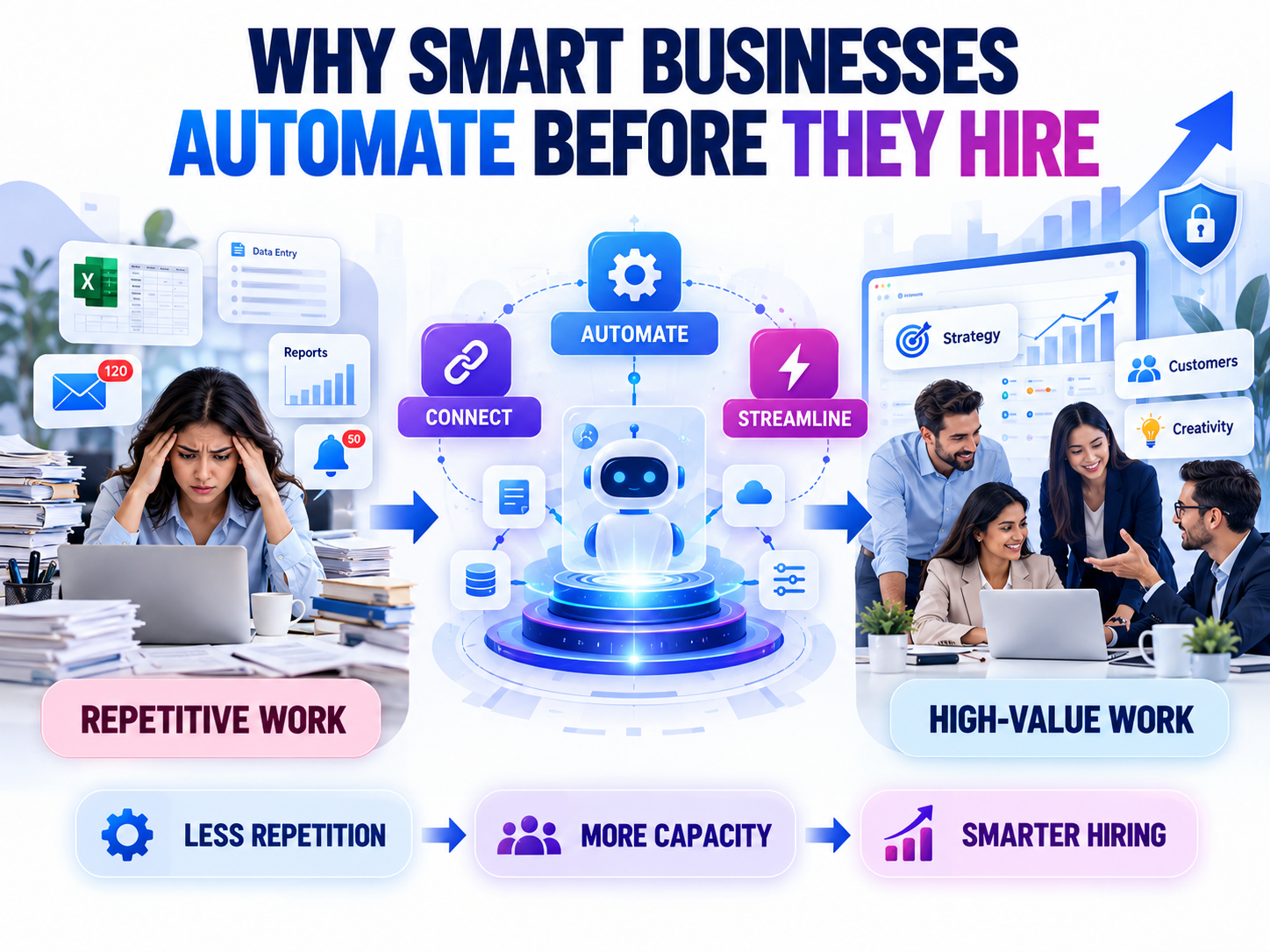
The goal should be to remove unnecessary repetitive effort so humans can focus on higher-value work.
How to Identify Manual Work That Should Be Improved
Before introducing technology, businesses should understand where manual work actually exists.
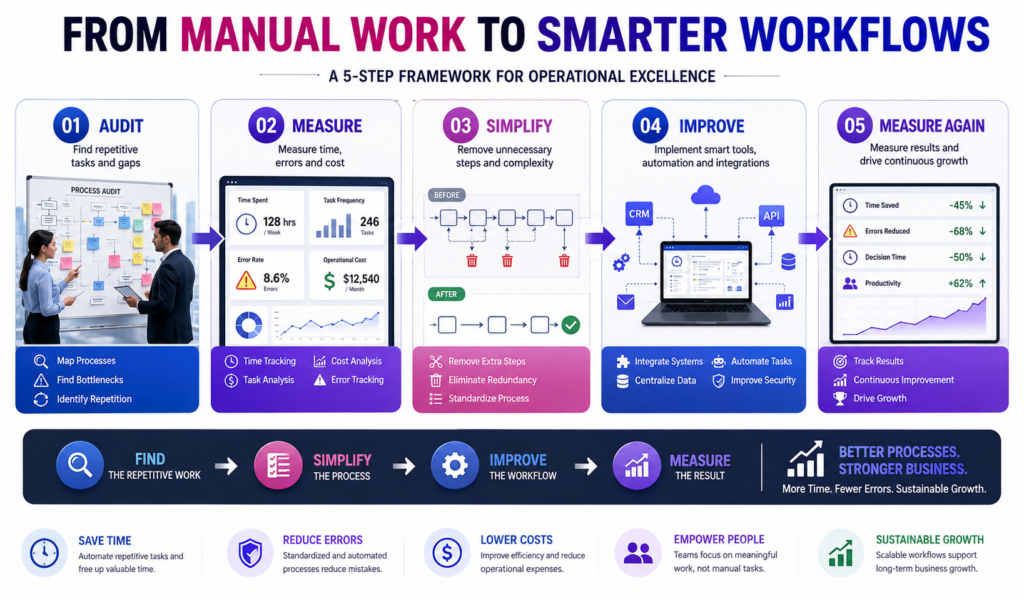
A simple process audit can reveal surprising inefficiencies.
Step 1: Track repetitive tasks
Ask employees:
- What tasks do you perform every day?
- Which tasks do you repeat every week?
- What information do you enter more than once?
- Which reports take the longest to prepare?
- Which tasks require copying and pasting?
- Where do errors happen most often?
The answers can reveal high-impact opportunities.
Step 2: Measure the time involved
Do not rely only on assumptions.
Measure how long each repetitive process takes.
For example:
| Process | Time per task | Frequency | Monthly impact |
|---|---|---|---|
| Data entry | 10 minutes | 20/day | ~67 hours |
| Report preparation | 2 hours | 4/month | 8 hours |
| Record verification | 15 minutes | 10/day | ~50 hours |
| File organization | 30 minutes | 5/week | ~10 hours |
The exact numbers will vary, but the principle remains the same.
A task that appears insignificant can become expensive when multiplied by frequency.
Step 3: Identify the highest-value opportunities
Not every manual task deserves immediate attention.
Prioritize processes that are:
- High volume
- Repetitive
- Time-consuming
- Error-prone
- Dependent on multiple people
- Dependent on multiple systems
- Related to sensitive information
- Directly connected to customer experience or revenue
These are usually the strongest candidates for process improvement.
Technology Can Reduce the Manual Workload
Once repetitive processes are identified, businesses can explore technology solutions.
Depending on the workflow, this could include:
- Workflow management systems
- API integrations
- Database-driven applications
- Document management systems
- Automated reporting
- Data validation
- Scheduled processes
- Business process automation
- AI-assisted tools
- Centralized dashboards
The right solution depends on the problem.
For instance, if employees repeatedly transfer data between two applications, an integration may solve the problem.
If employees repeatedly generate the same report, a dashboard may be more appropriate.
If employees repeatedly answer identical questions, a knowledge base or customer self-service system could help.
Technology should therefore follow process analysis, not the other way around.
Security Should Be Part of the Process Improvement
Reducing manual work can also improve process consistency, but organizations should avoid introducing new risks while attempting to increase efficiency.
Whenever a workflow involves sensitive information, businesses should consider:
- Who can access the information?
- Where is the data stored?
- How is it transferred?
- Are unnecessary copies being created?
- Are permissions reviewed regularly?
- Is activity logged?
- What happens when an employee leaves?
- Can the process be audited?
The CISA cybersecurity resources provide practical guidance for organizations working to improve their cybersecurity practices.
A well-designed process should balance efficiency with security.
Speed without control can create new problems.
Common Mistakes Businesses Make When Reducing Manual Work
Technology alone does not automatically create efficiency.
Several mistakes can prevent organizations from achieving meaningful results.
Automating a broken process
If a process contains unnecessary steps, simply digitizing it may make the inefficient process faster without actually improving it.
First simplify the workflow.
Then consider technology.
Introducing too many tools
Another common problem is tool overload.
Employees may end up using separate platforms for communication, project management, CRM, reporting, documents, and operations without proper integration.
Instead of reducing manual work, this can create more work.
The objective should be a connected workflow, not a larger collection of applications.
Ignoring employees
Employees understand operational problems better than anyone looking at a process diagram from outside.
They know which steps cause delays and where workarounds are necessary.
Therefore, employees should be involved when processes are redesigned.
Measuring only cost savings
Cost reduction is important, but it is not the only metric.
Businesses should also measure:
- Time saved
- Error reduction
- Customer response time
- Employee productivity
- Process completion time
- Revenue-generating activity
- Customer satisfaction
- Operational consistency
These metrics provide a much clearer picture of business impact.
A Practical Framework for Reducing Manual Work
Businesses do not need to transform everything at once.
A gradual approach is often more effective.
Audit
Document repetitive processes across departments.
Measure
Calculate the time, frequency, cost, and error rate associated with each process.
Prioritize
Start with high-volume, high-impact activities.
Simplify
Remove unnecessary approvals, duplicate data entry, and redundant steps.
Improve
Introduce appropriate software, integrations, or workflow improvements.
Secure
Review access controls, data handling, logging, and other security considerations.
Measure Again
Compare the new process against the original baseline.
This creates a continuous improvement cycle rather than a one-time technology project.
The Future of Business Efficiency Is Not About Doing More Work
Modern businesses often focus on productivity by asking employees to work faster.
But there is another question worth asking:
Why are employees doing this task manually in the first place?
That question can reveal opportunities that productivity targets cannot.
The future of efficient operations is not necessarily about asking people to complete more tasks every day.
It is about designing systems where people spend more time on meaningful tasks and less time managing repetitive processes.
This shift becomes increasingly important as businesses adopt cloud platforms, APIs, AI-powered tools, data systems, and connected workflows.
The companies that benefit most will not necessarily be the ones with the most technology.
They will be the ones that use technology to solve the right operational problems.
When Manual Work Becomes a Competitive Disadvantage
Two businesses can have similar products, similar teams, and similar customer demand but produce very different results.
Why?
Their internal processes may be different.
One company may spend hours manually preparing information before responding to a customer.
Another may have centralized information available immediately.
One team may manually reconcile data every evening.
Another may have consistent systems that reduce repetitive reconciliation.
One organization may spend its best employees maintaining routine workflows.
Another may give those employees more time to innovate.
Over months and years, these differences compound.
That is why manual work can become a competitive disadvantage without appearing in a company’s financial statements as a single obvious expense.
Conclusion
Manual work is one of the quietest barriers to business growth.
It rarely appears as a dramatic crisis. Instead, it slowly consumes employee time, increases operational costs, creates opportunities for errors, delays decisions, and makes scaling more difficult.
The relationship between manual work and business growth becomes particularly important as organizations grow. Processes that once seemed manageable can become expensive and complicated when customer volume, data, employees, and systems increase.
The solution is not to remove people from the business.
It is to remove unnecessary repetitive work from people’s responsibilities.
Start by identifying repetitive processes. Measure their real cost. Simplify them where possible. Then use appropriate technology to improve consistency, efficiency, and scalability while maintaining strong security practices.
Ultimately, business growth should not require an organization to perform the same amount of manual work at a larger scale.
The goal should be smarter processes, better systems, and more valuable human work.
For organizations looking to strengthen their technology and security approach while improving operational efficiency, exploring practical resources on modern cybersecurity and technology practices can be a useful starting point.
The businesses that address manual work early can turn saved time into innovation, better customer experiences, and sustainable growth.
Because sometimes, the biggest obstacle to growth is not a lack of opportunity.
It is the amount of time employees spend doing work that technology could help them do better.