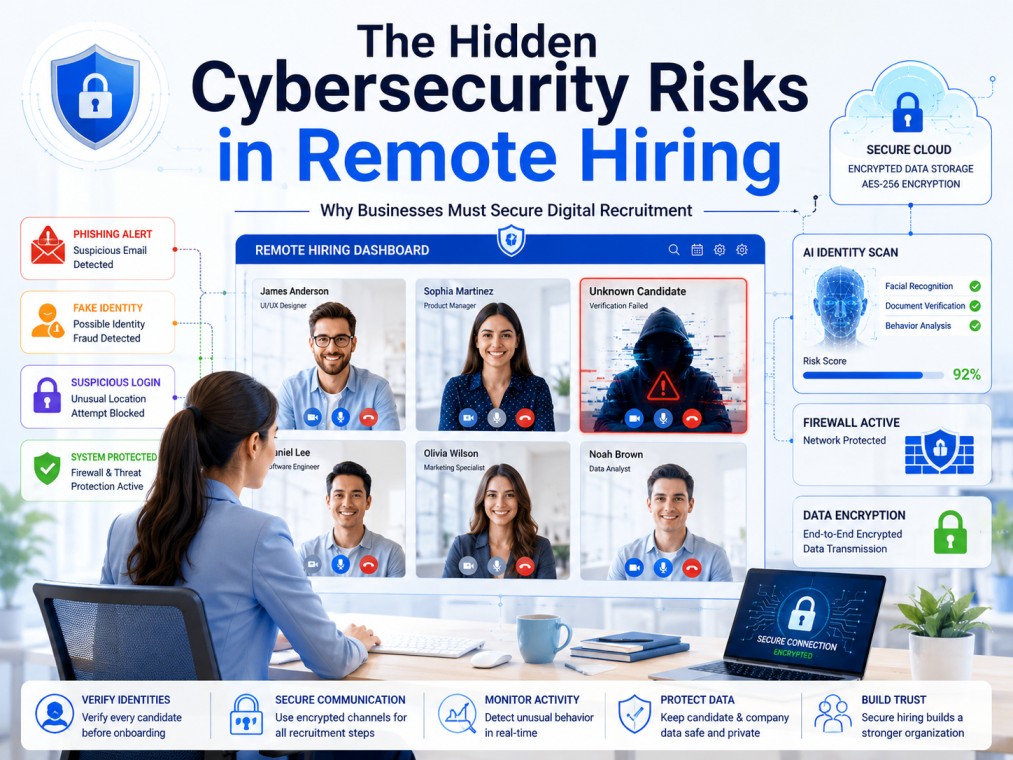
In today’s digital-first business environment, remote hiring has become more than a convenience—it’s now a core part of global workforce strategy. Companies can access international talent, reduce operational costs, and accelerate recruitment cycles without geographical limitations. However, while remote hiring creates opportunities, it also introduces a growing number of cybersecurity concerns that many organizations underestimate.
The reality is simple: every remote hiring process opens a potential digital entry point for cybercriminals. From fake candidate profiles and phishing attacks to insecure onboarding systems and identity fraud, businesses face hidden vulnerabilities throughout the hiring lifecycle. Organizations that fail to secure these processes risk exposing sensitive company data, financial information, employee credentials, and internal systems.
As cybersecurity threats continue to evolve, businesses must prioritize secure hiring workflows alongside productivity and talent acquisition goals. Platforms focused on proactive digital protection, such as BotDef’s cybersecurity insights, highlight how modern organizations can strengthen security practices in increasingly remote work environments.
This article explores the hidden cybersecurity risks in remote hiring, the real-world threats companies face, and the practical steps organizations can take to secure their recruitment and onboarding operations.
Why Remote Hiring Creates New Cybersecurity Challenges
Traditional hiring processes once relied heavily on in-person verification, physical documentation, and office-based onboarding. Remote hiring, however, shifts every stage online.
Recruiters now depend on:
- Video interviews
- Cloud-based HR systems
- Digital identity verification
- Online assessment platforms
- Remote onboarding tools
- Third-party communication apps
While these technologies improve efficiency, they also expand the organization’s attack surface.
Cybercriminals actively target recruitment teams because hiring workflows often involve:
- Sensitive personal data
- Financial information
- Employee credentials
- Access permissions
- Internal company systems
A single compromised hiring process can lead to ransomware attacks, credential theft, or large-scale data breaches.
According to the Cybersecurity and Infrastructure Security Agency (CISA), social engineering attacks and credential misuse remain among the most common causes of organizational security incidents. Remote hiring environments create ideal conditions for these attacks if companies lack proper safeguards.
The Most Common Cybersecurity Risks in Remote Hiring
1. Fake Candidate Profiles and Identity Fraud
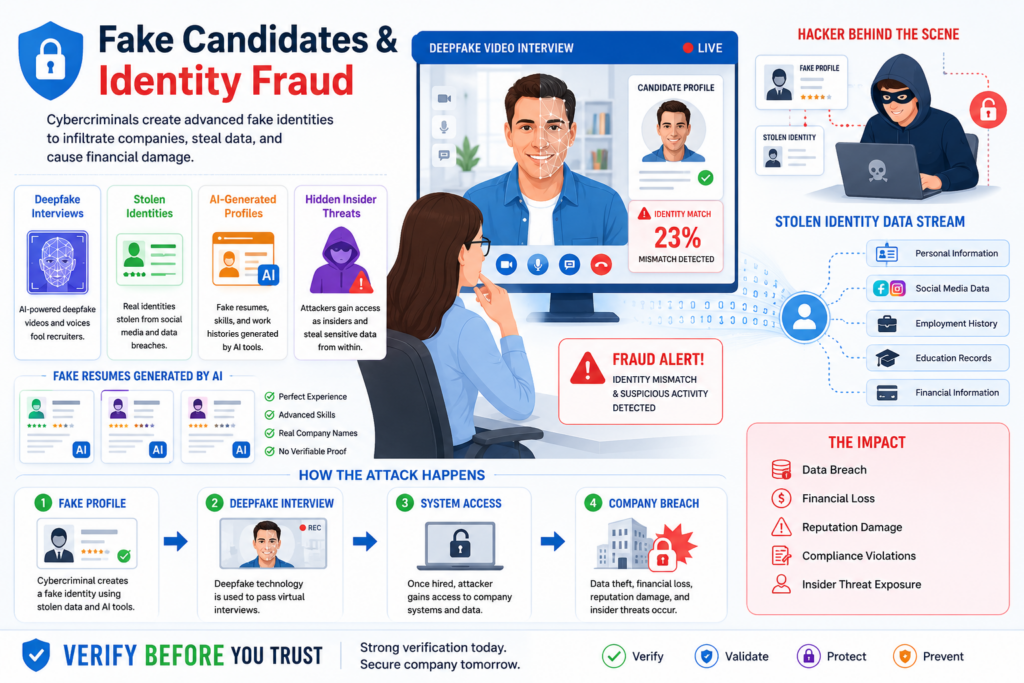
One of the fastest-growing remote hiring threats is candidate impersonation.
Cybercriminals increasingly create fake professional identities using stolen resumes, AI-generated profile photos, fabricated work histories, and manipulated credentials. Some attackers even use deepfake technology during video interviews.
The goal may include:
- Gaining access to company systems
- Stealing intellectual property
- Installing malware internally
- Conducting financial fraud
- Collecting sensitive employee information
In highly technical roles, attackers may attempt to infiltrate organizations as contractors or developers to gain privileged access.
Warning Signs of Fake Candidates
Recruiters should remain cautious when candidates:
- Avoid live camera interactions
- Provide inconsistent employment histories
- Use suspicious communication channels
- Refuse identity verification requests
- Submit unverifiable certifications
- Show mismatched technical skill levels
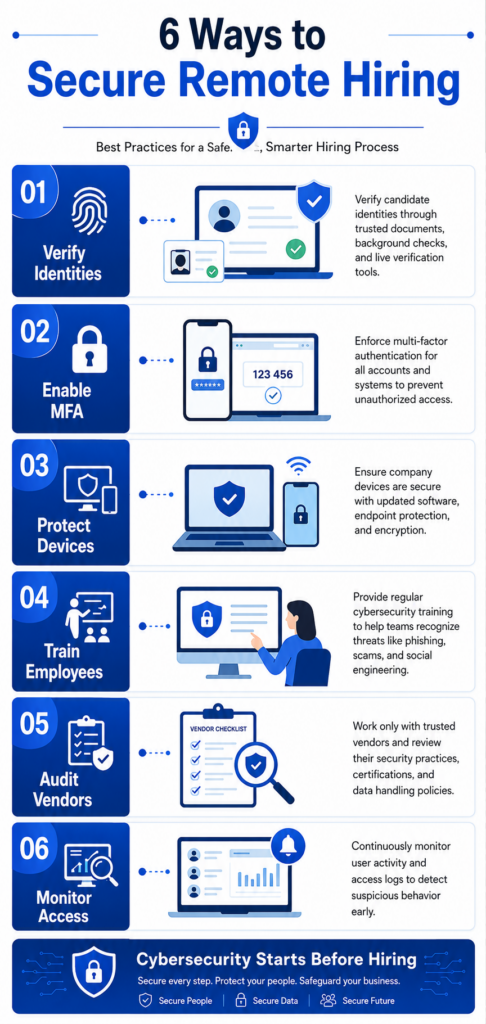
Organizations should implement multi-step identity verification processes before granting system access or onboarding remote employees.
2. Phishing Attacks Targeting HR Teams
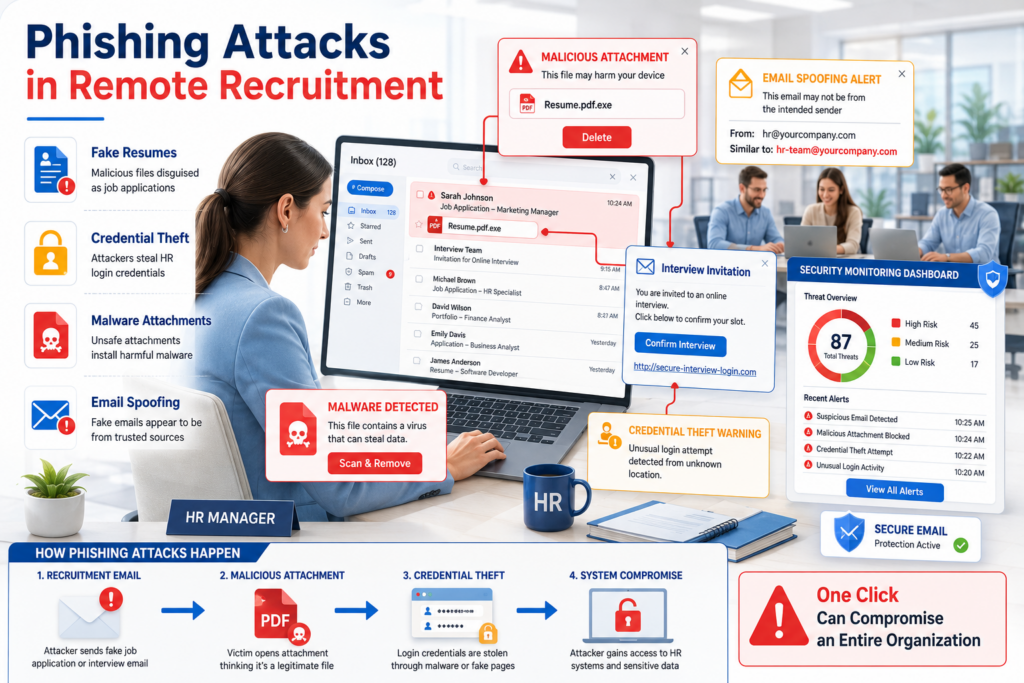
Human resource departments have become prime targets for phishing campaigns.
Recruiters constantly exchange emails, resumes, interview links, and attachments with unknown individuals. Attackers exploit this routine communication by sending malicious files disguised as:
- Job applications
- Portfolio documents
- Offer letters
- Interview schedules
- Resume attachments
Once opened, these files can install malware, spyware, or ransomware within the organization.
Why HR Teams Are Vulnerable
Recruitment teams often operate under time pressure. Large application volumes make it difficult to verify every communication carefully.
Attackers understand this behavior and craft convincing phishing campaigns designed specifically for recruiters.
Common phishing techniques include:
- Fake PDF resumes containing malware
- Credential-stealing login pages
- Spoofed interview invitations
- Cloud storage sharing scams
- Fake background verification requests
Businesses should strengthen email filtering systems and provide cybersecurity awareness training specifically tailored to HR personnel.
Organizations investing in broader security education often rely on modern security awareness resources like BotDef’s latest cybersecurity blogs to stay updated on emerging digital threats affecting business operations.
Insider Threats in Remote Work Environments
Employees With Unrestricted Access
Remote employees often require access to multiple internal systems immediately after onboarding. However, excessive permissions can create serious risks if not managed properly.
Without structured access controls, organizations may unintentionally expose:
- Customer databases
- Financial records
- Source code repositories
- Internal communication systems
- Cloud infrastructure
If malicious actors gain employment under false identities, unrestricted access can become catastrophic.
Best Practices for Access Management
Businesses should implement:
- Role-based access control (RBAC)
- Zero Trust security architecture
- Multi-factor authentication (MFA)
- Device authentication policies
- Access expiration protocols
- Continuous login monitoring
The principle of least privilege remains essential in remote hiring environments.
Employees should only access systems necessary for their specific roles.
Unsecured Personal Devices
Unlike traditional office settings, remote workers frequently use personal devices for work activities.
These devices may lack:
- Updated antivirus software
- Security patches
- Endpoint protection
- Encrypted storage
- Secure Wi-Fi configurations
As a result, compromised personal devices can become gateways into corporate systems.
Risks Associated With BYOD Policies
Bring Your Own Device (BYOD) policies can improve flexibility, but they also increase exposure to:
- Malware infections
- Data leakage
- Credential theft
- Unsecured applications
- Public network attacks
Organizations should establish clear endpoint security requirements before onboarding remote employees.
This includes:
- Mandatory security software installation
- VPN usage policies
- Device compliance checks
- Remote wipe capabilities
Third-Party Hiring Platforms and Supply Chain Risks
Recruitment Software Vulnerabilities
Modern hiring depends heavily on third-party platforms.
Applicant tracking systems, payroll tools, background verification providers, and collaboration apps all process sensitive company and candidate data.
However, every external integration introduces another cybersecurity risk.
If a third-party provider experiences a breach, attackers may gain access to:
- Employee records
- Interview communications
- Authentication credentials
- Corporate infrastructure details
Recent supply chain attacks have demonstrated how attackers increasingly target vendors instead of directly attacking large organizations.
Evaluating Vendor Security
Before adopting hiring platforms, organizations should assess:
- Security certifications
- Data encryption standards
- Compliance policies
- Incident response procedures
- Access management controls
- Historical breach records
Businesses should prioritize vendors with transparent security practices and regular vulnerability testing.
The National Institute of Standards and Technology (NIST) also provides valuable frameworks organizations can use to evaluate cybersecurity readiness across operational systems and vendor relationships.
Social Engineering During Remote Recruitment
Manipulating Human Trust
Cybersecurity threats are not always technical.
Many remote hiring attacks rely on psychological manipulation.
Attackers may impersonate:
- Executives
- Recruiters
- Candidates
- IT support personnel
- Background verification agents
These tactics aim to convince employees to share credentials, approve payments, or bypass security procedures.
Common Social Engineering Examples
Some common attacks include:
- Fake urgent hiring requests
- Fraudulent onboarding instructions
- Payroll modification scams
- CEO impersonation emails
- Remote IT troubleshooting scams
Because remote teams communicate digitally, verifying authenticity becomes more difficult.
Organizations should establish strict verification procedures for financial approvals, credential sharing, and onboarding communications.
Data Privacy and Compliance Risks
Handling Sensitive Candidate Information
Remote hiring involves collecting substantial personal data, including:
- Government identification
- Banking details
- Employment history
- Educational records
- Background verification data
Improper handling of this information can result in:
- Regulatory penalties
- Legal liabilities
- Reputation damage
- Customer distrust
Privacy regulations such as GDPR and various regional data protection laws require organizations to secure candidate information carefully.
Essential Data Protection Measures
Businesses should:
- Encrypt sensitive records
- Limit document retention periods
- Use secure cloud storage
- Restrict HR database access
- Conduct regular compliance audits
Clear privacy policies and transparent data handling practices are also essential.
Remote Onboarding Risks Many Companies Ignore
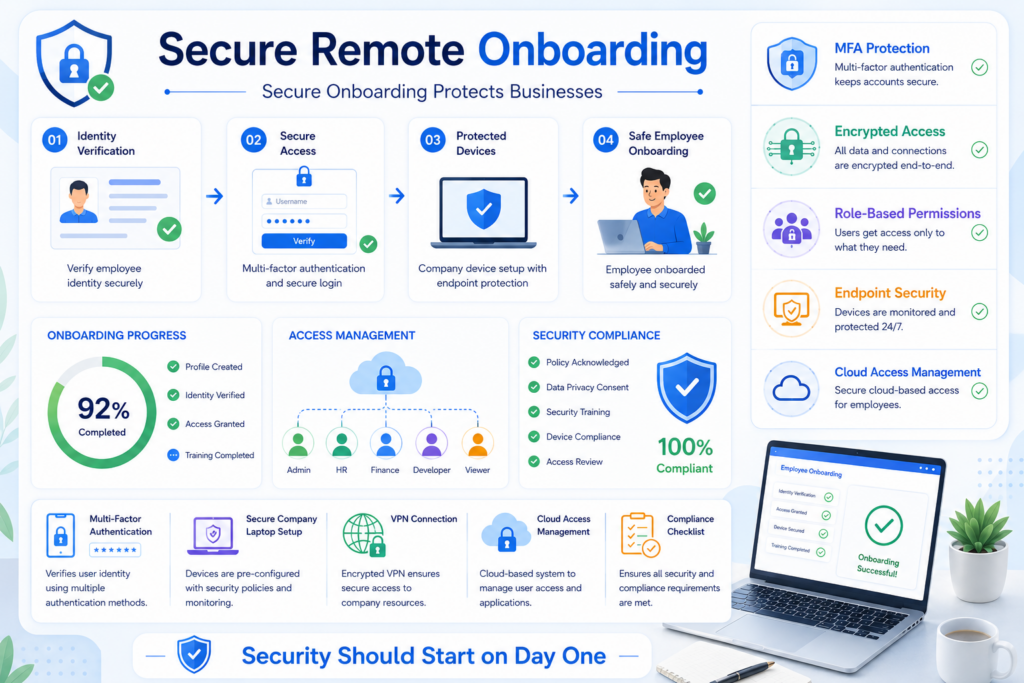
Weak First-Day Security Procedures
One overlooked cybersecurity issue is rushed onboarding.
Many organizations focus heavily on recruitment but fail to secure the onboarding process itself.
Common onboarding mistakes include:
- Sharing passwords insecurely
- Delayed account monitoring
- Incomplete access restrictions
- Missing endpoint configuration
- Unverified device usage
Cybercriminals often exploit these gaps immediately after account creation.
Building a Secure Onboarding Workflow
A secure onboarding process should include:
- Identity verification before account activation
- MFA enforcement during first login
- Secure password creation policies
- Endpoint security validation
- Security awareness training
- Automated access provisioning
Security should become part of the employee experience from day one.
How AI Is Changing Remote Hiring Threats
Deepfakes and AI-Powered Fraud
Artificial intelligence is transforming cybercrime rapidly.
Attackers now use AI to generate:
- Fake interview videos
- Synthetic voice recordings
- Realistic phishing emails
- Automated social engineering campaigns
- Fraudulent identity documents
Deepfake technology poses particular risks during remote interviews.
Recruiters may unknowingly interact with AI-generated candidates using stolen identities.
Defending Against AI-Based Threats
Organizations should adopt:
- Live identity verification tools
- Behavioral analysis systems
- AI-powered fraud detection
- Multi-stage interview processes
- Manual verification checkpoints
Cybersecurity strategies must evolve alongside emerging AI threats.
Building a Cybersecurity-First Remote Hiring Strategy
Security Must Be Part of Recruitment
Remote hiring security cannot remain solely an IT responsibility.
HR teams, recruiters, hiring managers, and leadership must collaborate to reduce organizational risk.
Key Components of a Secure Hiring Strategy
Businesses should focus on:
1. Cybersecurity Awareness Training
Recruitment teams should receive training on:
- Phishing detection
- Social engineering tactics
- Secure file handling
- Identity verification
- Safe communication practices
2. Secure Communication Channels
Organizations should use:
- Encrypted communication tools
- Secure video conferencing platforms
- Verified document-sharing systems
- Password-protected onboarding portals
3. Zero Trust Security Models
Zero Trust frameworks assume no user or device should receive automatic trust.
Every login, device, and access request should undergo verification.
4. Continuous Monitoring
Organizations should continuously monitor:
- Login behavior
- Access patterns
- Device activity
- Suspicious downloads
- Unusual account changes
Real-time monitoring significantly reduces breach detection times.
The Financial Impact of Remote Hiring Cybersecurity Failures
Cybersecurity incidents linked to remote hiring can become extremely expensive.
Businesses that want to stay ahead of evolving remote hiring threats should continuously follow trusted cybersecurity resources, practical security updates, and awareness-driven platforms. Staying informed about phishing prevention, secure onboarding, identity verification, and digital workforce protection can significantly reduce organizational risks. Many professionals also explore cybersecurity-focused educational resources through platforms like BotDef Security Updates & Resources to stay updated with the latest industry insights and protection strategies.
Potential costs include:
- Data breach remediation
- Regulatory penalties
- Legal expenses
- Operational downtime
- Reputation damage
- Customer loss
In some cases, a single compromised remote employee account can lead to organization-wide ransomware attacks.
Businesses increasingly recognize that cybersecurity investments are far less expensive than post-breach recovery.
Companies looking to strengthen long-term digital resilience often explore proactive cybersecurity strategies and threat prevention approaches through trusted educational resources such as BotDef’s security-focused platform for ongoing guidance and support.
Future Trends in Remote Hiring Security
What Businesses Should Expect
As remote and hybrid work models continue growing, cybersecurity challenges will become more sophisticated.
Future trends may include:
- Increased AI-powered impersonation attacks
- Advanced deepfake recruitment fraud
- Biometric identity verification
- Stronger compliance requirements
- Expanded endpoint security automation
- Greater use of behavioral analytics
Organizations that proactively strengthen hiring security today will remain better protected tomorrow.
Cybersecurity is no longer optional during recruitment—it is a foundational business requirement.
Conclusion
The hidden cybersecurity risks in remote hiring are growing rapidly as businesses continue embracing distributed workforces and digital recruitment processes. While remote hiring offers flexibility and global talent access, it also creates new attack surfaces that cybercriminals actively exploit.
From fake candidates and phishing scams to insecure onboarding systems and AI-powered impersonation attacks, organizations face complex cybersecurity challenges throughout the hiring lifecycle.
Businesses must move beyond traditional recruitment thinking and integrate cybersecurity directly into hiring operations. Secure identity verification, access management, employee awareness training, vendor assessments, and continuous monitoring are now essential components of modern workforce management.
Most importantly, organizations should treat cybersecurity as an ongoing strategy rather than a one-time implementation. Companies that invest in proactive remote hiring security will reduce operational risks, strengthen compliance, protect sensitive data, and build long-term trust in an increasingly digital business world.
As the future of work evolves, businesses that prioritize secure remote hiring practices will gain both operational resilience and competitive advantage.